‘The Heart of Belonging’: Bundles Scholar Chris Lawrence on Building Intergenerational Connections in East Harlem
Learn how his nonprofit, New Paths Nuevos Caminos Inc., is fostering cross-generational friendships Uptown.
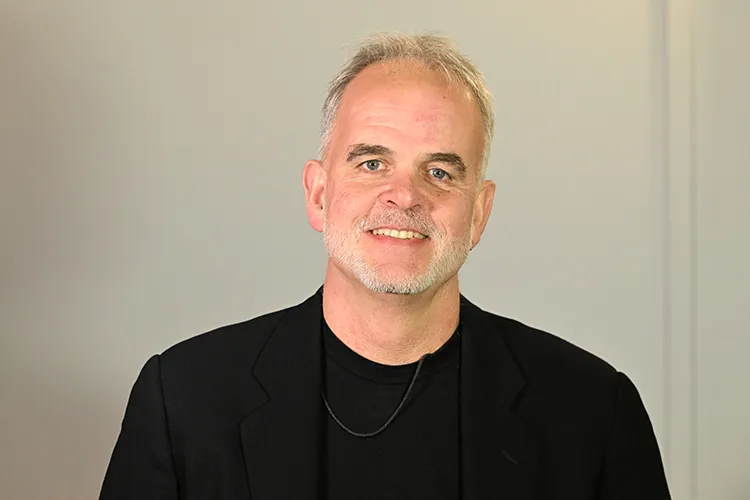
The strength of communities lies in the power of intergenerational connections. For social impact leader and A’Lelia Bundles Community Scholar Chris Lawrence, it’s a foundational principle that has guided his journey. The fond memories of stopping to spend time with his grandmother along his after-school bike route in Oxford as a child left an indelible impression on him. Now, he's brought his passion for building bonds across generations from England to East Harlem through the creation of his nonprofit, New Paths Nuevos Caminos (NPNC) Inc.
Launched earlier this year, the East Harlem-based nonprofit is designed to address the loneliness epidemic among aging populations by connecting high school students and community members with elderly residents living in local public housing developments. Through an array of immersive initiatives centered on micromobility, the arts, and gardening—including Cycling Without Age and Art in the Neighborhood—the organization has been instrumental in fostering affirming connections for local youth and the elderly.
The nonprofit also offers tech support and English language practice groups. Since its inception, NPNC has connected 20 students from four East Harlem-based high schools with 100 senior citizens through its programming.
Columbia Neighbors spoke with Lawrence about the vision and mission behind NPNC Inc., the most pressing challenges seniors in New York City are navigating, and how being part of the A’Lelia Bundles Community Scholars program contributed to the organization’s growth.
Growing up, were there any intergenerational spaces in your community that shaped your perspective on the power of connection?
I had a journey by bike while going home from my school in Oxford, England, which passed by where my grandmother lived. I made a habit of being with her for three or four visits every week, just for an hour or so to talk, and perhaps more importantly, to be listened to. It was not an easy time. My mother was unwell, and my grandmother gave me undivided attention. That’s been how my experience as a teenager 4,000 miles away has reaped results today in East Harlem.
What inspired you to lead community-driven work centered on aging communities?
Reconnecting with a friend, Sir Muir Gray, after many years of not being in touch. He helped to lead the Optimal Ageing Programme, part of the Oxford Longevity Project. He and colleagues gave attention to what we were doing in East Harlem and affirmed it. We took the experiences we had initiated when 16- and 17-year-olds from an East Harlem high school became involved in narrative history and portraiture using their phones to capture pictures of older residents in 2018 and 2019. This laid the foundation for what came after. We grew from this into a new organization dedicated to affirming the gifts and contributions of marginalized populations.
We added these amazing three-wheeled adaptive bikes [called trishaws], al fresco dining “sobremesa,” as well as music, art, and creativity events. We always knew we would be working outside of the “regular” hours because this was the only time students could be available: after 4 p.m. and on weekends, which is typically and precisely when senior centers all close their doors.
I remember seeing an advertisement on a subway car celebrating that NYC had 300 senior centers, and I wondered if people who were aging in NYC were indeed having the flourishing life that the ad represented. It created a bit of a reaction in me. I hadn’t known about the opportunities for high school students to use these centers, and I was reluctant to believe these 300 centers were being particularly motivated to include high schoolers except for a few weeks during their vacations. So, I had this passion to see how we could reengineer things a bit to bring these two populations together within one walkable neighborhood.
What led to the creation of New Paths Nuevos Caminos Inc.? What’s the significance behind the name?
We need a culture shift. We want our four high schools here in East Harlem to help us incentivize young people, 16- to 18-year-olds, to spend time with older adults living within five minutes of their school campuses in the neighborhood. There are as many older adults over 65 years old as the total population of school-aged children in these 100 blocks.
Informal befriending is what is needed. The “adopted grandparent” relationships are needed when the biological family support for these residents is nonexistent or very intermittent. We are creating a way for high schoolers to see the older adult populations around their school site as an opportunity for mutual support relationships—a stop on their way home.
We can imagine helping our older adult residents to grow abilities in listening skills, paying attention and finding ways to encourage young adults to talk and share what they're navigating in life. So, it’s about a new way of building relationships within an intergenerational model.
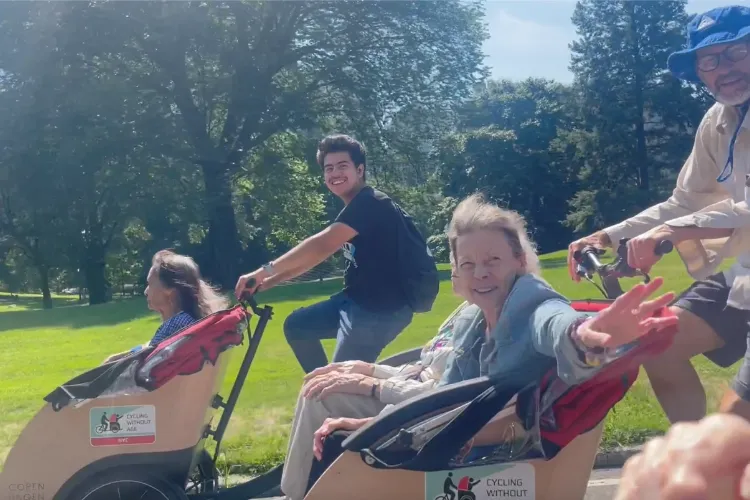
The name also supports our fascination with getting older adults to take rides on these amazing e-bikes, where they have a front-row seat as they are driven around the green spaces and waterfronts by young people who are trained to be pilots.
Can you share how hosting neighborhood programs helps cultivate a sense of belonging?
A big part of creating a sense of belonging is finding something meaningful to do together where we can shift our very natural focus on differences in age or culture towards what we can enjoy together. Through programs like Art in the Neighborhood and Cycling Without Age, we create opportunities for people to connect in a relaxed and genuine way. This could look like working on an art project, gardening, cooking and serving food together, making music, or sharing stories in a small group. Even something as simple as going for a trishaw ride has opened up wonderful conversations. The passengers are facing forward, taking in the neighborhood around them, while our pilots sit just right behind them. This often takes off the constant pressure of having to make direct eye contact or needing to think of something to start a conversation.
This is particularly important when we bring younger people who are generations apart from the seniors. Building a relationship with an older adult can feel intimidating, but when they’re preparing a meal or creating something with their hands, it gives the relationship a third space to develop on its own. They can contribute within that space and have a meaningful role to play. Compare this with the challenges of a 16–18-year-old trying to build a relationship with an older adult during a game of bingo with 30 other people sitting around in a senior center. I think many mean well and want to make an impact, so we want to help build that bridge.
We’re really trying to create opportunities for people from different generations to meet one another as equals. It will take a bit of problem-solving and creativity to bring people together in ways that feel natural, but when we don’t give up and get it “right,” something special happens. People start to feel comfortable with one another, conversations flow, and we’ve seen friendships grow. That’s the heart of belonging.
“People start to feel comfortable with one another, conversations flow, and we’ve seen friendships grow. That’s the heart of belonging.”
Yes, it starts with being present in a neighborhood or participating in a program. But ultimately, it’s about feeling that you have a place, that you have something to offer, and that you’re a part of something shared with others.
What are some memorable moments of connection from programs and events you’ve hosted through the nonprofit?
We met a Holocaust survivor who hadn’t been outside for many months and was overwhelmingly anxious about stepping outside. She took her first ride as a passenger on one of our trishaw pedicabs, and she spoke about it for weeks after.
We connected with high schoolers who recently arrived in the U.S. and are slowly improving their English through their education. They’ve been able to take on a leadership role in the bicycle project, as some of our passenger population are Spanish-speaking and really appreciate the students’ proficiency in Spanish when riding around and enjoying the cityscapes.
We’ve also had three generations of one family (from toddler to great-grandparent) taking a ride together! Another memorable moment was having spontaneous rhythms coming from members of a pop-up banquet who wanted to add to the musical vibe.
What are some of the most pressing challenges seniors in NYC are currently facing? How is NPNC Inc. filling the gaps?
Many seniors don’t have a significant conversation for 45 days at a time. They have acquaintances, but real friendships can be very sparse. We observed that there is a real loss of connection and isolation, which is harmful to mental health, as well as a loss of opportunity for those who could benefit from a reliable listening conversation partner.
In all the emphasis we place on providing services for senior citizens, we sometimes deflect from the importance of solid, repeated trust-building relationships, and frankly, proximity matters. We emphasize buddying programs based on living in the same neighborhood or based on going to school in the neighborhood so senior citizens don’t have to travel to be in the right place to meet people.
This is one of the underrecognized challenges for older adults: the ways that their mobility is often very restricted. They might have less motivation than we realize to get out to make the journey to places like senior centers outside of where they live.
We have a problem with trying to retain and recruit people to be “on-site” in senior centers that are not always as popular with residents as they could be. This is a problem of funding and providing a development pathway for those who work long hours to support older adults. The work done to promote informal support, such as what we are doing with high school students is off the radar and therefore misses the funding which can be siphoned up by more established agencies working homogeneously with just older adults.
We recognize that the challenge of finding ways to integrate older adult and young adult life in the way we are doing is still in its infancy. We cannot expect to be filling gaps if we don’t have a model that is demonstrable. So right now, we are still in its beginning stages and doing what we can to build a team based on proximity, shared city blocks, co-existence, and mutual support. The intergenerational agencies which exist in NYC often deploy young people remotely as phone support volunteers or as commuters to find older adults at locations across all five boroughs. We are unusually hyper-local and reliant on doing our work slowly, yet thoroughly, within a walkable neighborhood.
How has being part of the A’Lelia Bundles Community Scholars program shaped your vision for NPNC Inc.? How have the resources at Columbia contributed to the nonprofit’s growth?
At a crucial stage, we were able to host a panel and conversation at Columbia where we focused on the intergenerational challenges New York City is facing when it comes to connecting young people and older adults. We have had Columbia School of Social Work connect us with MSW practicum students to give us hands-on practical support in growing the participation of high school students with older adults. I have had networking opportunities with artists, interior designers, and entrepreneurs who have all provided inspiration and helped move things along unexpectedly.
We have been able to have the support of social work and health professionals as well as students because of a layer of endorsement and validation that comes through belonging to the A’Lelia Bundles Community Scholars family.
Can you share about the importance of creating spaces for intergenerational connection in communities like East Harlem specifically?
One major point is that we simply cannot hire enough paid professionals in a way that’s sustainable. In 10 years, there will be twice as many seniors over 80 years old in East Harlem. Volunteers, however, fill that gap through a mutually beneficial, win-win relationship-based approach. We are not only meeting the needs of some older adults, but we are addressing the losses experienced by young people who feel ignored or unseen.
So, we would say we are about growing a re-neighboring initiative based on a people-friendly urban village, right here in the middle of densely populated East Harlem. It sounds quaint, but actually it is about rootedness and belonging “in place.” It is understood by sociologists and urban planners as a life-giving resource in neighborhoods like ours.
“We are not only meeting the needs of some older adults, but we are addressing the losses experienced by young people who feel ignored or unseen.”
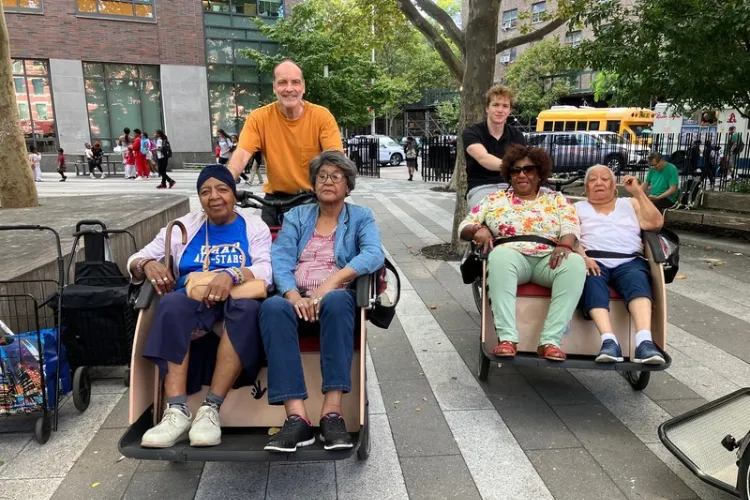
Often, the designated places where senior citizens are expected to congregate are not the easiest or best places for young people to hang out, even if the opening hours are compatible. We have created pop-up banquets and concerts on children’s play areas; we have made use of a fleet of trishaws (pedicabs) to get groups of older adults to the East River and Randall’s Island or parts of Central Park where they have never been. We also have plans to develop a garden as an art space for sculpting and ceramics using a potter’s wheel.
We need unconventional intermediate spaces that are easy for residents to get to because they are on-site or right next door to senior housing. We need a micromobility solution to help groups attend events and reclaim places, which is what NPNC Inc.’s Cycling Without Age NYC program is already achieving.
What are some ways individuals can begin building intergenerational connections within their own communities?
Think of the triangle and creating a common third. Young people need a way of being with older adults, and it’s important to have a third focus that is authentic, a good fit, and actually fun. We might think of making and eating food together, doing handcrafts that are appropriate for the young person and easy to do. Storytelling gets the focus away from just the person speaking, as they are together entering into a narrative world.
What’s on the horizon for NPNC Inc., and how can people get involved?
On May 15, 2027, we’re hosting our Crossing Manhattan Connecting Generations fundraiser, which we’d love for people to sign up for. It’s a bikeathon and walkathon, where people can ride regular two-wheeled bicycles or do a two-hour walk. It is the one day we try to bring in most of the cash we need for a year’s worth of core program costs. We invite people to join in whatever way they can. We also have “try-it-out” sessions for the trishaws on Sundays during the summer season.