How Harlem’s Children’s Art Carnival Shaped This Teaching Artist’s Creative Journey
Uptown Triennial 2026 artist robin holder reflects on her journey with the Carnival and its impact on local arts education. Her work is now on view at Columbia’s Wallach Art Gallery.
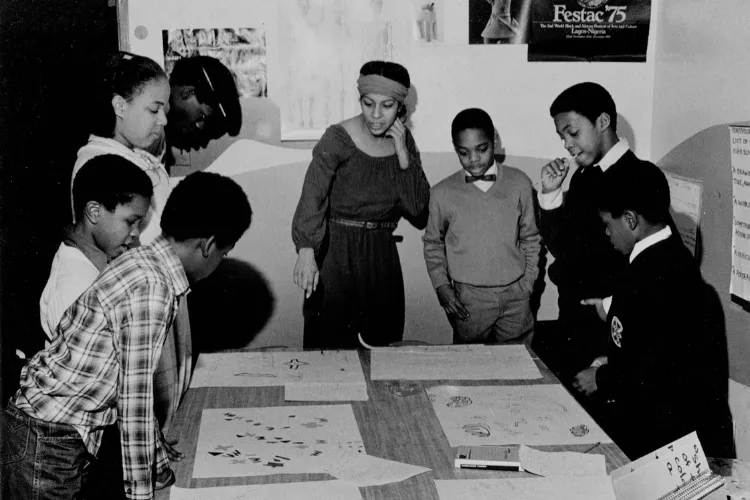
For Chicago-born, New York City-raised artist, activist, and educator robin holder, lessons in the arts are far more expansive than color theory and crosshatching. Creative expression, she said, carries a depth that invites us all to learn from lived experiences, explore diverse perspectives, and unpack unspoken truths.
Embedded within holder’s vibrant collection of mixed-technique prints and paintings are pertinent messages about the nuances of social justice, cultural identity, and the human condition.
“I'm almost obsessively fascinated with the differences that people experience, not only nationally but globally,” holder said. “Their religion, race, economic status, position in their society, access or lack of access to resources and information. I'm always listening to what people have to say, and I've been very intrigued by how people identify themselves and who they believe they belong to.”
When she walked through the doors of Harlem’s Children's Art Carnival (CAC) in 1978 as a teaching artist—a role she remained in for nearly 10 of the over 40 years she has worked as an art educator—she made it her mission to empower Harlem youth to use art-making as a conduit for curiosity, experimentation, and creative expression.
Now, through her work featured on Columbia University’s Manhattanville campus in the Wallach Art Gallery’s latest Uptown Triennial exhibition, Children’s Art Carnival in Harlem: The Making of Contemporary Artists, holder offers a lens into how her time at the Uptown nonprofit influenced her artistic vision 40 years ago.
holder’s decision to examine societal issues through her art stems from a range of experiences throughout her life. Growing up in a progressive and politically active, multicultural family with African American, Caribbean, Russian, and Jewish roots informed the messages she wanted to voice through her work and motivated her to use art to illuminate inequity while inspiring meaningful discourse. Those roots also gave her the license to speak truth to power.
That approach is evident in collections like USA: United States of Anxiety, which examines the social impact of the shifting American manufacturing industry, and Our Social Skin, which explores societal identity in relation to U.S. federal holidays.
That sense of authenticity and awareness at the core of her practice is what would ultimately lead her to develop a vibrant relationship with CAC founder Betty Blayton. In the late 1970s, after studying under Robert “Bob” Blackburn at his printmaking workshop in Chelsea—where Blayton served on the board of directors—holder began teaching at the Carnival.
Immersing herself in the organization’s family-like community was a turning point in in her career and personal life. She saw arts education as an avenue to address societal issues by motivating her students to harness their imaginations, consider possibilities, build skills, and think critically.
holder, an alum of the High School of Music & Art in Harlem—now known as Fiorello H. LaGuardia High School of Music and Art and Performing Arts—focused on accessibility, guiding students in building portfolios and preparing for entrance exams at her alma mater and other specialized arts schools in New York City. She also taught drawing courses and led teams of local teenagers in painting murals on the restroom buildings in nearby Harlem parks.
It was at the Carnival that a shared love for uplifting youth through the arts led her to meet her late longtime partner, fellow teaching artist Steve Mayo who taught ceramics, painting, and drawing workshops and is also featured in the Uptown Triennial exhibition.
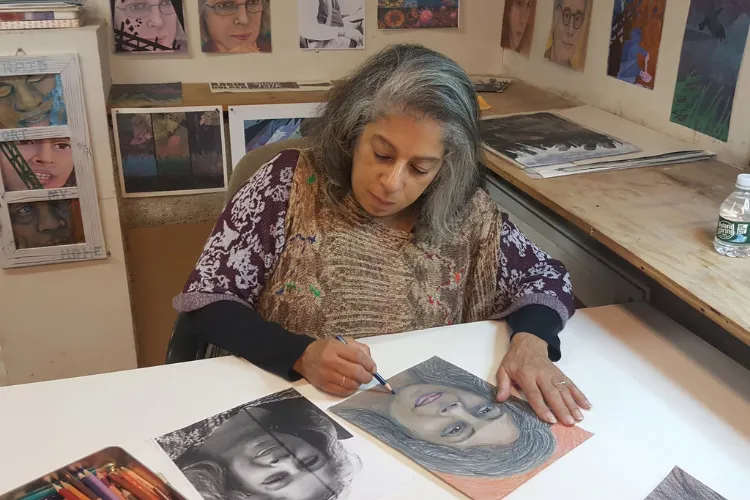
holder worked at the Carnival during a period when Harlem was plagued by economic disinvestment, but the organization remained a pillar that sustained the momentum of the neighborhood’s vibrant creative and cultural legacy. When developing lesson plans, holder noted she kept the cultural and racial realities of the Harlem community foremost in her thinking.
“In any community—but particularly in communities of Black and Brown people and immigrant children and families—it is absolutely necessary to have a platform and a vehicle by which people can share their experiences, ask questions about each other, become familiar with the realities of others, and learn how to empower self by expressing the truth that they're living,” she said.
That belief anchored the community-driven courses she led at the CAC. Her portfolio preparation class was a skills-based series covering composition, form, proportion, and texture. She said she also worked to discern the level of visual arts literacy the students had, and what kind of behavior modalities they were comfortable with. Beyond guiding youth in building technical skills, she implemented Blayton’s broader vision of taking a holistic approach to arts education, centering creative exploration and discovery in her work as an educator at the CAC.
“Betty's entire approach was based not only on cultural and racial awareness and understanding many layers of complexity, but also on a spiritually creative comprehension of how art, art-making, exploration, discovery, questioning, daydreaming, and playfulness are all sources of motivation for an artist.”
“There was a real comprehensive approach,” holder said. “Some of my students at the CAC were not aware of New York City’s specialized public art schools. So, the importance of extended knowledge of available resources was valuable. Betty's entire approach was based not only on cultural and racial awareness and understanding many layers of complexity, but also on a spiritually creative comprehension of how art, art-making, exploration, discovery, questioning, daydreaming, and playfulness are all sources of motivation for an artist.”
The transcendent theme of spirituality is interwoven in her Warrior Women Wizards: Mystical Magical Mysteries series; three works of which are currently on view at Uptown Triennial 2026. The exhibition celebrates the CAC’s legacy in Harlem by amplifying the work of contemporary artists connected to its history. The body of work, which she began creating while teaching at the Carnival, is inspired by candid conversations she had with Blayton about metaphysics.
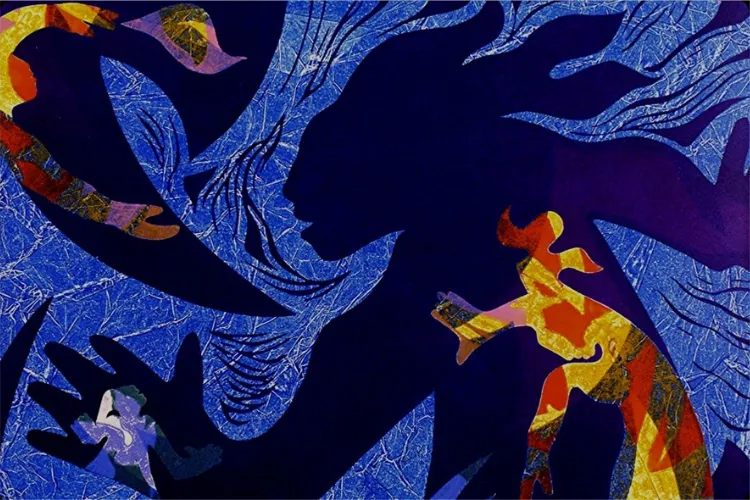
The three vibrantly hued linoleum and stencil monotype prints depict women surrounded by flora and fauna, exploring how nature, womanhood, and spiritual and emotional power are interconnected.
“Warrior Woman is a series that I worked on for a number of years,” said holder. “I wanted to identify the very specific energies, roles, partnerships, and challenges women are confronted with and deal with. The images were inspired by life, humanity, the earth, nature, metaphysical thought, and exploring what place women have in the grand scheme of the universe. Those are the kinds of things that I constantly reflect upon and try to deconstruct, evaluate, and respond to in my work.”
“The images were inspired by life, humanity, the earth, nature, metaphysical thought, and exploring what place women have in the grand scheme of the universe.”
holder said she hopes that gallery-goers who stop by the Uptown Triennial art show, on view through Sept. 13, come away with a reverence for Blayton’s vision of arts education as a tool for community impact.
“For me, this exhibition is about presenting a community that Betty founded, nurtured, and developed of creative artists, administrators, and educators who are devoted to teaching on an extraordinarily creative and compassionate level,” holder said. “Those who are committed not only to art, art-making, teaching, and learning about art, but also to being part of a considerate, proactive community. I hope the show inspires people to see themselves as originators and directors of their own destiny.”