Uptown Triennial Celebrates Children's Art Carnival as Harlem Cultural Cornerstone
‘Children’s Art Carnival in Harlem: The Making of Contemporary Artists’ is on view at the Wallach Art Gallery on Columbia's Manhattanville campus through Sept. 13.
Behind the crimson red doors and ornate façade of the historic townhouse sitting at 62 Hamilton Terrace—home to the Children's Art Carnival (CAC)—lies a legacy of artistic innovation and activism that expands far beyond its walls. When celebrated artist and educator Betty Blayton, one of the founding members of the Studio Museum in Harlem, took the helm of the program in 1969, she envisioned a safe space where Uptown youth could channel their creative expression, imaginative ideas, and self-reflection through the arts amid shifting political and societal landscapes.
From neo-expressionist painter Jean-Michel Basquiat, who created silkscreen prints at the CAC, to influential Harlem-born creatives like Dindga McCannon and Janet Olivia Henry, who served as educators at the nonprofit, the stories of every artist, student, instructor, and volunteer form brushstrokes within the portrait of Blayton’s greater vision for community impact. Nearly 57 years after its inception, the CAC remains a creative haven in Harlem, hosting community-driven workshops and open studios rooted in making arts education accessible for youth and championing emerging and established artists who contribute to the neighborhood’s vibrancy.
The CAC's impact and influence are illuminated in the latest iteration of the Wallach Art Gallery’s Uptown Triennial, a recurring exhibition series that centers the work of artists who live and practice in Upper Manhattan. Children’s Art Carnival in Harlem: The Making of Contemporary Artists is curated by Souleo, a creative and impresario who has uplifted Blayton’s unsung work through written reflections and past exhibitions. The show is a cultural archive that embodies the essence of communal joy, creativity, and a deep reverence for Blayton—the Renaissance woman who shaped the CAC.
Columbia Neighbors spoke with Souleo about how the CAC has transformed the local community, Blayton’s legacy, and the curatorial vision behind the Uptown Triennial, which is on view now through Sept. 13.
How did you become involved with the Children's Art Carnival?
In January 2023, Betty Blayton’s brother, Oscar, who serves as the executor of her estate, reached out and shared an idea for an exhibition highlighting the work of artists affiliated with the Children's Art Carnival. I was familiar with her work at the Studio Museum in Harlem, and I worked on an art exhibition with AARP back in 2013 that included some of her artwork. After she passed away in 2016, I noticed there were no major outlets writing about her legacy, and I wrote a story for Hyperallergic to amplify her contributions to the arts.
The following year, as part of the inaugural Uptown Triennial at Columbia University, I curated seven of the satellite galleries that were associated with the exhibition. One of those shows, hosted at the Elizabeth Dee Gallery, was a solo retrospective of Betty’s work. It got coverage in The New Yorker and opened the door for other opportunities to create and curate exhibitions centering her work. I think organizing these shows where people can experience her artistry in-person has contributed to the renewed interest in Betty’s work.
What’s the origin story behind the CAC?
In 1942, the Children's Art Carnival was launched by Victor D'Amico (TC 1930), who was a teaching artist and the founding director of the Department of Education at the Museum of Modern Art. It was built on the foundation of centering the child in art education. Before that, art education in museums and other spaces was very regimented and rigid.
What was really groundbreaking about the Children's Art Carnival is that it was built on the concept of children having their own creative imagination and ideas, and the need for them to have more creative freedom in that exploration, which was forward-thinking for the time. That vision for championing youth arts education spread globally. There was international reverence for what the Carnival was doing in terms of art education and fostering new ideas.
The Carnival traveled to trade fairs in Europe, including the Brussels World's Fair in the 1950s. There was also an NBC television show produced in collaboration with MoMA called “Through the Enchanted Gate,” which D'Amico hosted. In 1963, Indira Gandhi—who went on to become India’s first and only woman prime minister—met with former first lady Jacqueline Kennedy Onassis to explore how India could channel the Carnival’s creative energy. They launched a satellite program in New Delhi that eventually became a permanent exhibition at the National Children's Museum.
Fast forward to 1969. Amid the Civil Rights Movement, Black Power movement, and Black Arts movement, there were calls for social justice, and different industries and institutions were trying to figure out how to respond and build programs that were rooted in equality. MoMA initially wanted to launch an outreach initiative bringing arts-centered school programs to underprivileged youth throughout New York City.
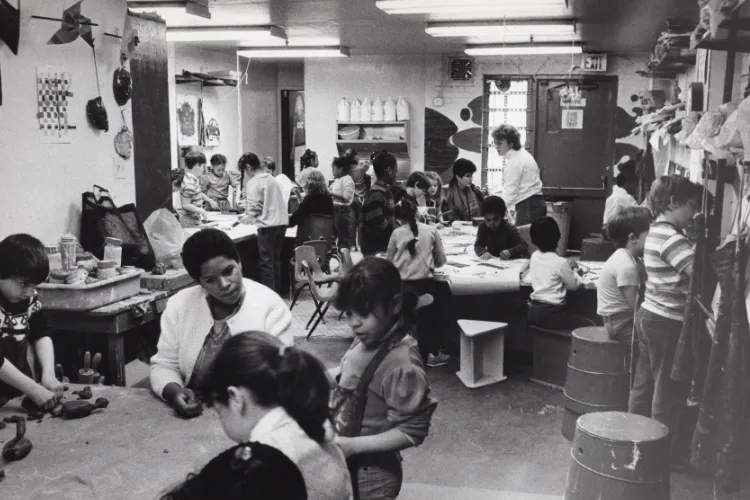
That year, the Children's Art Carnival established a program in Harlem at 641 St. Nicholas Ave., a former garage provided by the Harlem School of the Arts. D'Amico was the consulting director for the program, and Betty Blayton became executive director. The program enrolled children from local New York City public schools and those who were part of service programs and community organizations in the neighborhood. In 1974, it legally separated from MoMA, became its own nonprofit, and moved to a renovated townhouse at 62 Hamilton Terrace, where it remains today.
The program offered a robust selection of workshops covering art forms including painting, puppetry, ceramics, fashion design, and graphic art—it really ran the gamut! It began to blossom, so much so that organizers broadened the reach and accepted students ages 4 through 21. Beyond its offerings for youth, the Carnival worked with the New York City Department of Education and led accredited workshops for parents, teachers, and school administrators based on its methodology. There was even a literacy element of the program called “Creative Reading Through the Arts.” It generated empirical evidence on the value of creativity and education.
What is the importance of having arts education-driven institutions like the Children's Art Carnival in communities like Harlem specifically?
It is just as significant today as it was back then. No matter how much progress people of color have made in this country, we always have to be vigilant because we know at any moment things can revert and be reversed. Politically, we see grants for humanities and arts programs being cut. There are attacks on what gets taught in the classrooms and on diversity, equity, and inclusion. When all of those things happen at a national level, it always impacts historically marginalized communities the most.
That’s one of the reasons the Carnival came to Harlem; it was a historically marginalized, underrepresented, and undervalued community. Those living within the neighborhood needed a space to thrive. We need spaces like the Carnival where we can gather and find inspiration, education, and networks that will help us sustain each other no matter what the social and political climate may be like outside of that space. If people like Betty Blayton and the other folks who led the Carnival during the 1960s and 1970s could create spaces like this back then—in some aspects against harder battles—there’s no excuse for not doing it now.
We need spaces like the Carnival where we can gather and find inspiration, education, and networks that will help us sustain each other no matter what the social and political climate may be like outside of that space.
Who are some notable artists who came through the Children's Art Carnival, and how have they shaped the legacy of the organization?
We’ll start with one of the biggest names: Jean-Michel Basquiat. When I was writing the piece about Betty Blayton for Hyperallergic, I learned he was an intern at the Children's Art Carnival in the 1970s. When you think about his origin story, that association is never mentioned. People often talk about his connection to Andy Warhol, the downtown arts scene, and how that helped him foster his creativity and career success, but there was a whole period before that when Basquiat was immersed in community programs.
Learning he was part of the Carnival reframes the narrative. It illustrates how the organization was an important part of his foundation and helped him become successful. There’s a video of Betty Blayton within the exhibition where she talks about how he used the Carnival’s print shop Uptown to create silkscreen prints he would take downtown. Basquiat’s work has elements of raw creative energy, and that’s something the Carnival encouraged artists to embrace.
Basquiat’s work has elements of raw creative energy, and that’s something the Carnival encouraged artists to embrace.
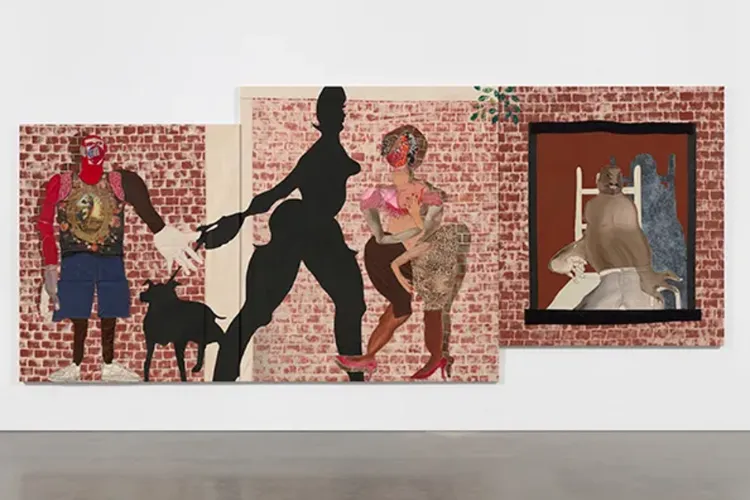
Tschabalala Self—one of the leading contemporary artists working today—took classes there as a student. The Carnival was impactful for her in terms of representation and seeing people who looked like her in the art world who were creating and having success. There's Dindga McCannon, Janet Olivia Henry, Senga Nengudi, and Beverly Semmes—all major names in the art world who were instructors at the Carnival.
I think the fact that so many major artists were affiliated with the Carnival speaks to the value of these spaces, because they helped to lay the foundation and influence the direction of their practice. It gives them the opportunity to network and find community. I think that’s really special.
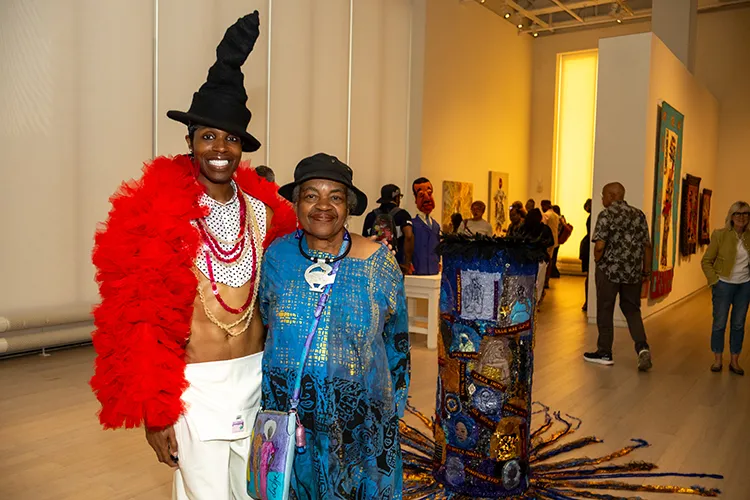
Many of the artists discussed how their practice shifted as a result of their experience with the Carnival. I think for them, being around Betty, working with youth, and surrounding themselves with other like-minded artists and creatives opened new portals for them and created a sense of affirmation. It was all about tapping into who you are, who you wanted to be, and not being afraid to evolve.
Beyond the students and instructors, what has the Children's Art Carnival meant for community members?
It’s all about community enrichment, collective care, and putting the focus on the grassroots support that sustains us. Milagros Batista, one of the artists in the exhibition, makes wearable art and, beyond her creative work, is a community organizer and activist. For someone like her, the Carnival is a space where she can combine her activism with her art practice. She leads a lot of intergenerational workshops at the Carnival. Many of the workshop participants have experienced marginalization, so she brings them into a space where they can support each other and have a respite to relax, create, imagine, and have conversations about life and art.
What inspired the curatorial direction of the exhibition? What story did you want to tell?
In terms of curation, there was some tension within myself regarding how much of the show would be about the Carnival’s history as an organization and how much would be centered on the art that was produced through it. There’s so much amazing archival material around the organization that a completely separate show could be done from the arts education angle.
Since the Wallach Art Gallery is a contemporary art space, I wanted to make sure it was balanced and really led with the art. It was about looking at art that reflected the influence the Carnival had on the artist. I initially wanted to incorporate a “before and after” element featuring pieces artists created before they got to the Carnival and after, to illustrate the change. That approach worked in a few cases.
We also wanted to represent the Carnival’s history, so we have a timeline and vintage, rarely seen photos that contribute to telling the organization’s story. That timeline breaks everything down in an accessible way and brings to the forefront some of the key highlights and even challenges the Carnival has experienced, and how it’s moving through it all and reinventing itself today. We also included short interviews with each artist, where they share first-person accounts of their experience with the Carnival.
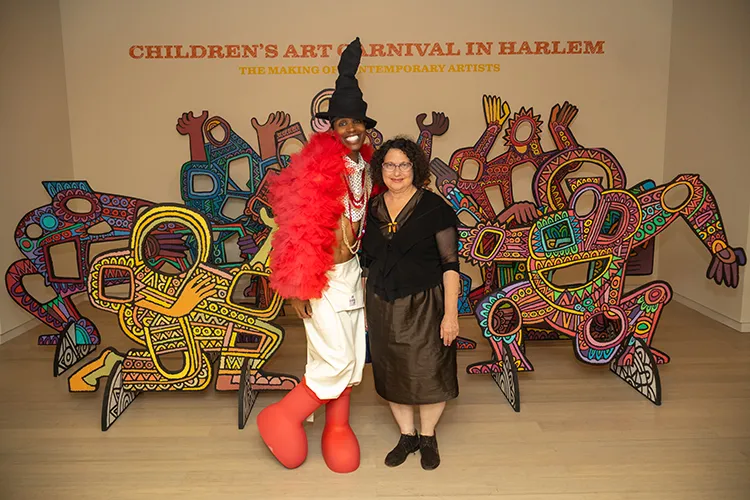
Overall, when it came to the curatorial direction, I wanted to make sure there was a feeling of joy. I wanted to create a carnival-esque atmosphere because the Carnival was also known for having block parties and street fairs in Harlem. I wanted to make sure that sense of childlike fun resonated throughout the space, and you’ll see that not only through some of the archival imagery but also through the artwork as well. For example, Emmett Wigglesworth has these very colorful sculptures with face cutouts at the entrance of the exhibition. It’s reminiscent of carnivals and street fairs.
I wanted to create a carnival-esque atmosphere, because the Carnival was also known for having block parties and street fairs in Harlem. I wanted to make sure that sense of childlike fun resonated throughout the space.
If you could choose one word to describe the vision behind the art show, what would it be and why? What do you hope folks walk away with after experiencing the exhibition?
The word I would choose is celebration. We’re celebrating this underrepresented organization. We’re celebrating Betty Blayton. We’re celebrating the Carnival’s leaders. We’re celebrating the artists, some of whom are big names and some of whom deserve to be. We’re celebrating the volunteers and administrative staff. We’re celebrating community. We’re celebrating the power of art and how it can be a great space for education, community, and joy.
I hope people walk away from the exhibition feeling inspired, because inspiration is what keeps the world moving. Without inspiration, we’re not dreaming, imagining, or envisioning. I hope people are inspired by the stories of Betty Blayton and Victor D'Amico. I hope they’re inspired by the art, because there’s so much to take in for each individual work, whether it’s capturing a message about social justice or spirituality.
It may just inspire them to go home and create a little drawing themselves. The Carnival has always been about using art to tap into your inner self.