How to Make Connections Uptown, From the Founder of Ms. Steph’s Science Club in Harlem
Stephanie Farmer, the founder of Ms. Steph’s Science Club and longtime Harlem resident and Columbia Community Service grantee, shares her advice for tapping into the local community for those new to the area.
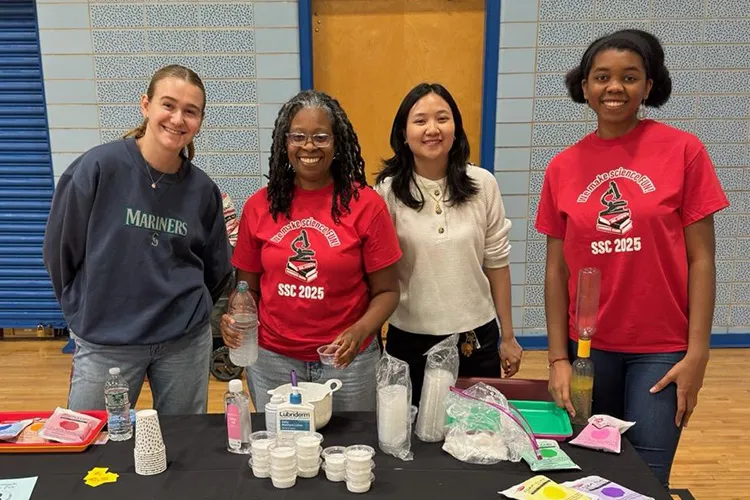
Stephanie Farmer moved to New York City in 2003 with little more than a messenger bag and a plan to make it big as the perfect sonic mix of India.Arie and Mahalia Jackson. She arrived just in time for a citywide blackout, and fondly remembers settling into an empty apartment and lighting candles, just as she had as a child during the typhoons on an Air Force base in the Philippines.
Growing up, Farmer moved every four years, plus some smaller moves in between, as part of a military family.
“That’s one major part of who I am and how I function, how I run programs,” Farmer told Neighbors. “I attribute my sense of order and my ability to go ‘Well, I actually have six plans in the backup chamber if need be,’ to that.”
It wasn’t an accident she picked Harlem as a new arrival to the city when she finally landed somewhere for good.
“I wanted to live where the Black people lived, frankly,” Farmer said. “This was the first community I’d experienced that was predominantly that.”
Although she came to the city to sing, she had studied biochemistry and worked in it after college. Once she was in the neighborhood, she found herself pulled more toward Harlem’s after-school programs, first as a volunteer, then as a program director for a church-affiliated nonprofit’s mentorship program in 2006.
What she noticed during those formative years would inform the rest of her career: kids getting two hours a day of reading and math, but maybe one hour of science a week. And that was rarely hands-on.
“It boggled my mind,” Farmer said. “One of the core cities on the planet and we don’t have better science education.”
That’s where the idea for Triple F Empowerment, Inc., home to Ms. Steph’s Science Club, was born. The club is named to differentiate itself from a camp or a class.
“I wanted the students to have a feeling of belonging as well as ownership,” Farmer said. “You come because you want to.”
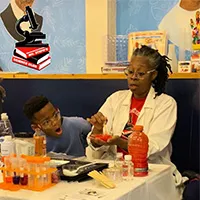
Every Saturday during the school year, Harlem youth participate in hands-on experiences in science, technology, engineering, arts, and mathematics (STEAM), each infused with a little silliness and joy. Every summer, Farmer hosts a month-long science immersion camp with weekly field trips to places like Liberty Science Center and the Bronx Zoo. She also tables at as many community events as she can get to.
“It is serious, but science can also be the silliest subject in the world,” Farmer said. “You can be so silly.”
This year, Farmer’s programs have reached 980 unique children. That’s on top of the nearly 10,000 children she’s reached since she started the nonprofit in 2012.
Farmer has built Triple F Empowerment almost entirely through relationships. First, it was a faith community she joined a month after she moved to the city. Then, a dance instructor who dared her to branch out and start her own after-school program. And also through Columbia Community Service (CCS), which she was introduced to by a longtime friend and A’Lelia Bundles Community Scholar Vivian Williams-Kurutz.
This year, Columbia News is publishing a “Choose Your Own Adventure”-focused Columbia Welcome series for newcomers starting at the University this fall, and, to be honest, we immediately thought of Ms. Steph as the perfect neighbor to lend her expertise on tapping into the local community.
Ms. Steph’s Advice for Making Connections Uptown
1. Ask for Help Genuinely and Specifically
This advice isn’t abstract for Farmer. Running a nonprofit largely by herself while managing chronic illness taught her something she repeats constantly to the young people who come through her program.
“I don’t have to do this by myself, and neither do you,” Farmer said. “Ask for help, ask for help, ask for help and we can get quite a bit done.”
That advice extends to Upper Manhattan itself and to newcomers who might be intimidated by it.
“People in New York will help you,” she said. “Now, don't get your feelings hurt if they say it bluntly: ‘Look here, you've got to go over here.’ They may say it that way, but my experience has been that’s said as a force of helpfulness.”
2. Get Involved Intentionally. Volunteer!
For Columbia students specifically, Farmer points to CCS, a campus program that connects students, faculty, and staff to volunteer opportunities at nonprofits across Harlem and Morningside Heights. It also raises money from faculty, staff, and retirees to directly support local nonprofits.
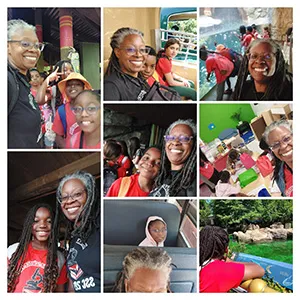
Triple F has been a CCS grantee for years, and Farmer said the difference it’s made for her “micro” operation has been significant. At least a quarter of her CCS-connected volunteers end up staying with the organization for multiple years.
“Trying to get volunteers for a small organization is hard, especially when people assume: well, this organization's only got one staff person, what movement can they really be making?” she said. “A lot, actually.”
One of her steadiest recent volunteers works at one of Columbia's labs; she found Triple F through the CCS volunteer listings. The work is fun, with volunteers passing out science kits of cups of slime at summer street fairs.
“So many adults have had a negative experience with science,” Farmer said. “I make a point of my PhD-level volunteers getting to do the experiments too. It’s as much for them as it is for the kids.”
3. Remember You’re Entering Someone Else’s Home Space. That’s a Skill to Develop.
Farmer’s Air Force upbringing was where she first learned the art of reading the room. It has become central to how she runs Triple F’s Traveling Science Teacher program, which brings hands-on science directly into classrooms and community spaces across Upper Manhattan.
“I always treat it like I’m a guest until I’m invited to do otherwise,” Farmer said. “New York is a conglomerate of all these different places and cultures. Observe, humbly ask. Don’t assume anything.”
Quick Tips with Ms. Steph: Where to Go and How to Help
Favorite park spot?
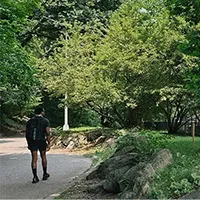
Morningside Park, hands down, especially the stretch of benches between 121st and 123rd Streets, and the pond around 113th and 114th. This is also the site of Kids Fest, an annual event Farmer connected with through CCS. She has a favorite tree, too, near PS 180 around 120th and 121st.
“Yes, I'm that much of a nerd,” Farmer said. “It's beautiful. It's huge. I like to see it when it turns.”
Where to find scientific inspiration Uptown?
“Science is everywhere,” Farmer said, but her go-to categories are simple: any museum (the American Museum of Natural History is pay-what-you-wish as a New York resident), any zoo or wildlife conservatory, and any park. [Editor’s note: We’ve got a guide just for that!]
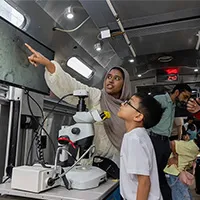
She also pointed to BioBus, the mobile science-lab nonprofit she's collaborated with for years.
How can people support Triple F and Ms. Steph’s Science Club?
Volunteer, first and foremost, said Farmer. But beyond that, the most direct ways to help are following @mssteph_tfe on Instagram and Triple F Empowerment Inc. on Facebook (where she posts daily and also shares free science experiment ideas), donating, spreading the word, or signing up as a Traveling Science Teacher location. Triple F can visit a block party, a classroom, or a single event.
“It’s not about growing us,” Farmer said. “It’s about making sure more kids get fun science, through more adults knowing about us.”