Columbia Graduating Senior Jasmine Velasco Wants to Improve Culturally Responsive Healthcare in The Bronx
Velasco discussed her goals in oncology, the influence of her Bronx upbringing, and what graduation means to her.
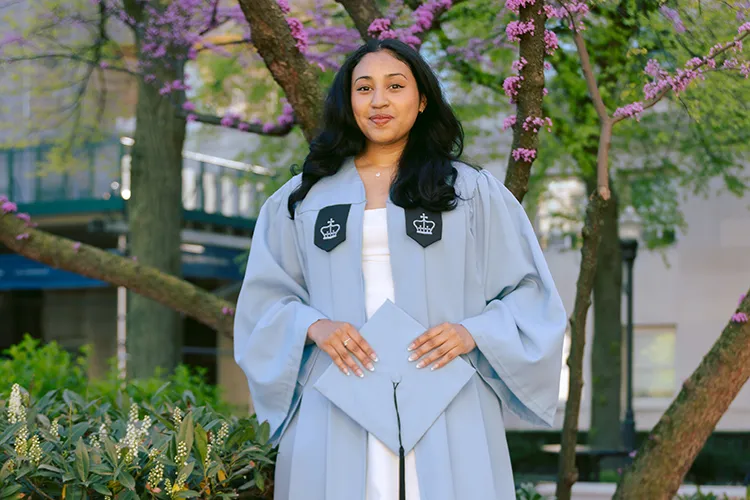
Growing up in Fordham Heights, Jasmine Velasco (CC’26) came to the realization that communities are only as strong as the systems designed to support them.
The first-generation Dominican and Mexican American student said watching her parents navigate the healthcare system and hearing neighbors’ stories about their own harrowing experiences revealed gaps in culturally responsive care and inspired her to pursue medicine and change the narrative.
Combining her lived experiences and her studies in cognitive science at Columbia College, Velasco, who’s charting a path in oncology, is on a mission to improve healthcare outcomes for those who feel neglected by the system in the Bronx and beyond.
Ahead of University Commencement, Columbia Neighbors spoke with the soon-to-be graduate about how the Bronx inspired her journey, the importance of cultivating third spaces for community-driven healthcare, and what graduation symbolizes for her.
How has your Bronx upbringing served as a source of inspiration along your journey?
I grew up in Fordham Heights, which is a low-income area within the Bronx. I used to be part of a youth ministry group at a local church in our neighborhood called St. Simon of Stock and St. Joseph Catholic Church. My youth minister would always encourage us to aim higher and reach further, emphasizing the importance of pursuing higher education.
Something she’d always say that I’ve carried with me is: “Become a statistic of the Bronx, but make sure it’s a positive one.”
That statement has really grounded me throughout my journey and inspired me to want to represent my neighborhood in a positive light. I wanted to show the people where I’m from that we can work up to stepping into spaces where we’re not often represented. Growing up in the Bronx really motivated me to keep striving and working hard.
My decision to pursue a path in medicine stemmed from the gaps I saw within my own neighborhood. I saw a lot of people in my community navigate different types of disabilities and suffer from medical problems. Through casual conversations with older people in my neighborhood, I realized many of them didn’t feel fully understood when they entered medical settings for care.
In the future, I’m excited to be a familiar face to someone and, hopefully, bring them some comfort in their medical care.
What led you to Columbia?
What brought me to Columbia was the sense of community I felt when I stepped on campus. During my tour, seeing people hang out and socialize across campus in between classes really stood out to me. I think it’s important to have that balance, especially in such a rigorous academic environment.
The educational opportunities here are enriching, and the student life events really elevated my experience. I came to Columbia with the expectation that it would be very challenging in terms of academics—and, trust me, the road hasn’t been easy—but having supportive professors and spaces where you can just “be” really made my time here special.
What sparked your interest in cognitive science specifically?
I’ve always been curious about how the brain works and how people think. In general, I don’t think people realize how external factors—like where you grew up—shape the brain and how that, in turn, shapes different aspects of your life. Seeing my little brother, who is six years younger than me, grow up and go through different stages of curiosity and exploration and reach new milestones was really intriguing. That interest is something that carried over into my studies at Columbia.
Outside of my courses, I volunteered at Teachers College’s Cognitive Neuropsychology Lab, where we focused on exploring how monolingual and bilingual children develop differently in terms of cognitive milestones. It was interesting to see how the development side plays a big role in cognitive science.
It helped me understand how people process things emotionally and how they deal with psychological trauma tied to life-changing diagnoses, which will be beneficial for me as I step into the oncology field. I’m super appreciative I’ve been able to essentially learn these things to effectively and empathically help guide people during tough moments in their lives and support them in caring for their health in digestible and manageable ways.
How can culturally responsive healthcare uplift communities?
I’m a Dominican and Mexican first-generation, and my parents are immigrants. In the Bronx, there were—and still are—a lot of hardworking first-generation families that reflected the makeup of my own.
Witnessing my parents’ experiences with the healthcare system and seeing them be timid in communicating their health concerns to medical providers who may not be culturally informed was difficult. When it comes to managing health, there are methods of at-home care that are specific to certain cultures, and it can be challenging to explain them to a medical professional who may not understand them.
I took a class this semester called How Race Gets Under Our Skin: Race, Health, and Biomedicine, and it explores the racial inequalities within the healthcare system and the importance of tackling them. One of the things that stood out to me from this course was the cultural and environmental influences on healthcare outcomes and the need to understand a patient’s background. We discussed having more healthcare-focused community spaces in under-resourced neighborhoods that are hit hardest by disparities; spaces where people can connect over their experiences and dispel medical misinformation.
I think creating spaces that bridge medical professionals to everyday people is really important and will help people have more positive experiences overall.
From your perspective, what makes the Bronx special?
The Bronx is super fruitful and full of opportunity. I’ve met some of the most creative thinkers and hardworking people there. I feel like people have a completely different drive because we’re often painted in a negative light—the people I’ve met don’t subscribe to those stereotypes. The Bronx is filled with a lot of cultural enrichment and a true sense of community. Every time I go back to Fordham Heights in the summer, it’s so lively. There are people playing music, socializing, and playing dominoes. Seeing how people of different generations interact with each other is amazing.
“We’re here to represent our families, our communities, and to show what’s possible.”
Another thing that’s special about the Bronx is its large immigrant community, and although they all have different cultural backstories, they all share the same experiences around raising families in America. That spirit of community is present here on campus, too. I’ve met some other Bronx-born students here at Columbia, and a lot of them share the same story of being a first-generation American. We’re here to represent our families, our communities, and to show what’s possible.
For many people who come from low-income communities, attending a prestigious institution like Columbia can feel unachievable, but I think the fact that we’re here makes it very apparent that if you stay confident in yourself, anything is possible.
Can you share a local Bronx-based community hero or leader that you admire?
Cardi B is the first person that comes to mind. She’s a global superstar and has amassed a lot of success, but something she’s always held true to is her Bronx roots. She makes it known she’s from the Bronx, and she also celebrates her culturally rich Dominican and Trinidadian heritage, which is something I admire. I love how she uses her music and performances to tell stories; the traditional Dominican cultural elements she included in her “Bodega Baddie” performance on Saturday Night Live were amazing. She exemplifies success and achievement: beyond her music, she’s done a lot of things for the community.
What does graduation symbolize for you?
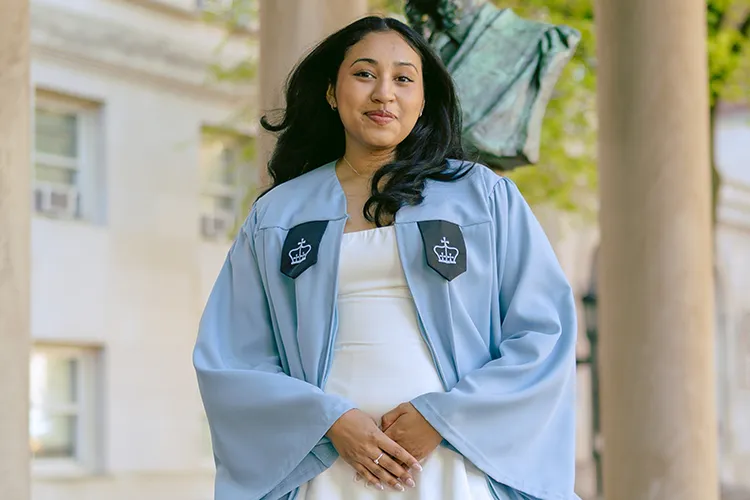
It’s a milestone that I’m proud of. I worked really hard to reach this level of higher education. This accomplishment isn’t only for me; it’s for my parents as well. They worked so hard to provide for me throughout my educational journey. They came to America when they were 18, and I personally couldn’t imagine going through the things they went through while in search of better opportunities. Their sacrifices have really motivated me to do my best.
Reflecting on your time at Columbia, what are you most proud of?
Before starting college, I was super introverted, and my time here at Columbia has helped me find my voice and become more of a social person. I have the confidence to casually chat with people on campus or spark conversations in class—something I definitely never would have done before. I’m really proud of the community I’ve built here.
What is one of the best pieces of advice you’ve received that you would share with the next generation of Columbia scholars?
A closed door is not a locked door. You have to find the drive within yourself to quiet the doubt, overcome challenges, work hard, open doors for yourself, and step into new spaces. Never let a closed door intimidate you, because although it may be closed, it’s not locked, and you can get through it eventually.
I’d also add that being “uncomfortable” is a good thing because it means you’re challenging yourself and learning something new, and that’s something I’ll bring with me as I transition into healthcare. Another piece of advice I’d share is that opportunities are always present at Columbia, academically and socially. You have to be intentional about seeking them out.
What’s on the horizon for you?
I plan on going into radiation therapy and administering chemotherapy for cancer patients. I’ve been able to shadow at Memorial Sloan Kettering Cancer Center, and I hope to work there in the future. Helping people through difficult times is something I’m very passionate about. Post-grad, I also want to take the knowledge and experiences I’ve had and focus on giving back to my community. I want to put my degree to use where I’m from.
I’d like to get more involved with the Bronx Oncology Living Daily (BOLD) Cancer Center. Columbia students have a chapter at the BOLD Center, and I’ve volunteered with their weekend on-call outreach. I’d like to continue to build upon that work.
Most importantly, through whatever I decide to do in the healthcare field, I want to motivate students from the Bronx and show them what’s possible.