Calling Local Businesses: This Program at Columbia Business School Could Help Solve Key Challenges
The Small Business Consulting Program is a student-led pro bono consultancy for startups and small businesses in New York City. Applications are now open for its next cohort.
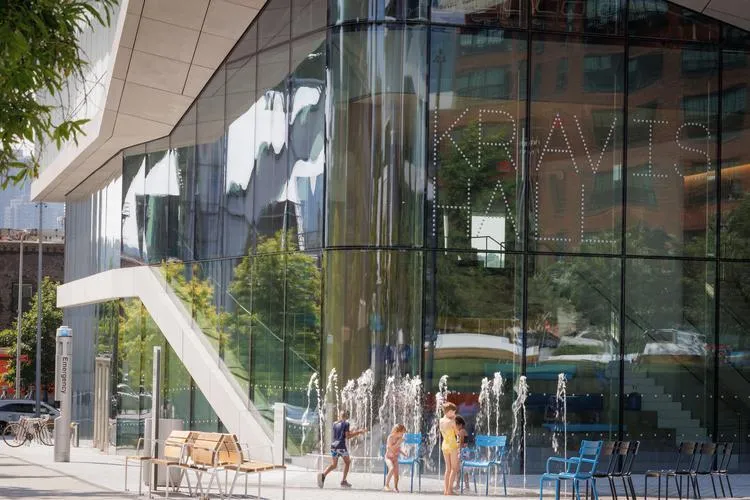
Columbia Business School has long partnered with the local community to offer knowledge, mentorship, and resources to support professional and economic development. From its first-generation entrepreneurs program to student-led initiatives like the Community Impact Club, which provides local students with interview-skills training and more, the Business School continues to build connections with neighbors both on and beyond the Manhattanville campus.
The Small Business Consulting Program (SBCP), a student-run organization supported by the Tamer Institute for Social Enterprise and Climate Change, is the latest example of that commitment. Through the program, Columbia Business School students pursuing MBA and Executive MBA degrees provide pro bono consulting services to small businesses and entrepreneurs throughout New York City.
Ahead of the program’s application deadline for businesses to participate in its next cohort on Sept. 8, Columbia Neighbors sat down with Mustapha Jechi, SBCP vice president and current student pursuing a dual MBA and Executive MS in Engineering and Applied Science, to learn more about the program’s work and its growing focus on businesses in Harlem and the Bronx.
Pro Bono Consulting for Local Businesses
How does the program actually work? The Small Business Consulting Program connects eligible small businesses with teams of Columbia Business School students who apply their classroom knowledge to real-world business challenges.
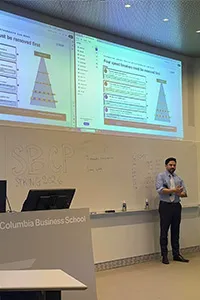
Participating businesses can receive support in areas including growth and scaling, problem identification, strategy development, solution mapping, and other forms of strategic consulting. After businesses apply and are assessed for eligibility, student teams are matched with projects based on their interests and expertise.
Jechi has found the true value of the program to be in identifying opportunities that small business owners may not have time or resources to uncover on their own, due simply to the demands of running a business day-to-day.
“I worked with a client in the spring that I think was spending an extra three or four thousand dollars on software they just didn’t need,” Jechi said. “There are real cost savings, and there are real opportunities to figure out where they can optimize things.”
Last year, SBCP worked with three businesses based in Upper Manhattan. This year, the organization hopes to more than double that number, with a particular focus on expanding its reach among businesses in Harlem and the Bronx.
Building Connections Uptown
Expanding the program’s reach in Upper Manhattan is part of a broader effort to strengthen connections between Columbia students and the communities surrounding the University.
Many SBCP students live in Upper Manhattan, creating opportunities for the program to connect classroom learning with the businesses and entrepreneurs in their own communities. The program has also seen businesses return for subsequent application cycles, often seeking support for new challenges as their organizations evolve.
“We’ve supported a whole host of industries including sustainable architecture, food and beverage, education and EdTech, sports and fitness, hospitality and restaurants, fashion, consumer goods, transportation, and wellness, to name a few,” Jechi said.
The Tamer Institute plays an important role in helping the student organization identify potential clients and build relationships with local organizations. Pat Lily, assistant director at the Tamer Institute, and Lawrence King, a senior advisor, serve as advisors to Jechi and have helped connect the program with nonprofits and businesses across Upper Manhattan.
Their work has included introducing Jechi to local businesses and providing opportunities to learn more about the neighborhood’s entrepreneurial landscape. Among those connections was NiLu Gift Shop, a Harlem-based business that Jechi visited with Mark Pinn, the store’s co-owner.
Who Can Apply?
The Fall 2026 cohort will run from October through December of 2026. Over the course of eight or more weeks, participating businesses will work with Columbia Business School students to develop strategies and solutions tailored to their needs, at no cost to the business. The application deadline is Sept. 11, 2026.
These are the eligibility requirements to participate in the program:
- Have been operating for at least 18 months
- Have reached at least $10,000 in monthly recurring revenue (MRR)
- Have at least one full-time employee or a permanent physical location
- Be based in New York City, with businesses in Harlem and the Bronx particularly encouraged to apply
- Participate in an in-person kickoff meeting at the beginning of the semester
- Commit to weekly check-ins with the student consulting team, either online or in person
- Agree to standard statements of work and not require a Non-Disclosure Agreement (NDA)
Local business owners interested in participating can learn more about the Small Business Consulting Program here and submit an application right here.
For Jechi, the program represents an opportunity to bring Columbia’s resources into closer relationship with the entrepreneurs and businesses that make Upper Manhattan home.
And for those looking for a local recommendation while spending time on the Manhattanville campus, Jechi has one more personal favorite: grab a smoothie at the locally-owned Oasis Jimma Juice Bar in the Business School’s Henry R. Kravis Hall.