Harlem Artist José Ortiz on the Lasting Impact of The Children’s Art Carnival
The Uptown Triennial 2026 artist shared his journey from student to educator at the Carnival. His work is now on view at Columbia’s Wallach Art Gallery.
When Afro-Dominican multimedia artist and educator José Ortiz boarded the C train from Harlem to LaGuardia High School on Manhattan’s Upper West Side to attend a high school fair in the late 80s, the then-middle schooler didn’t know that a glimpse of his destiny awaited him at the end of the subway ride.
It was the first time he had ventured outside his Hamilton Heights neighborhood. Once he arrived at the prestigious high school, the creative energy that echoed through its halls opened his eyes to the possibilities of a future in visual arts.
“I had a budding interest in art at the time, and attending that fair at LaGuardia solidified my curiosity,” he told Columbia Neighbors.
Ortiz was introduced to the visual arts through ArtsConnection, a program that brings arts instructors to New York City public schools to teach courses for a year. However, there wasn't any consistent arts-focused programming at his Uptown junior high school, but his Spanish teacher, Mr. Gonzalez, organized the trip to broaden students’ perspectives on what they could accomplish as creatives.
Decades later, Ortiz—whose portfolio includes permanent artwork at the 183rd Street and Jerome Avenue subway station in the Bronx—would bring that vision of making the arts accessible into his role as an educator at the Children's Art Carnival in Harlem. Now, through his work (which is currently on view at Wallach Art Gallery’s Uptown Triennial exhibition, Children’s Art Carnival in Harlem: The Making of Contemporary Artists), Ortiz is reflecting on art, education, and community.
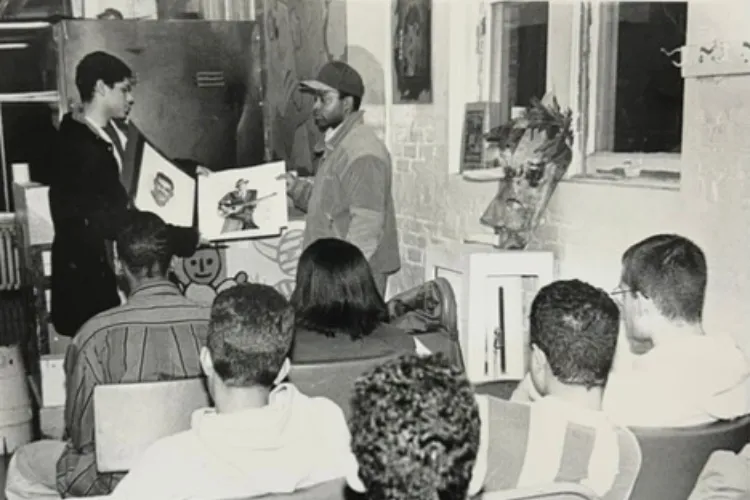
Ortiz’s journey with the Carnival is one of many chapters. After discovering his passion for the arts at the LaGuardia art fair, a classmate who told him about free arts workshops at the Carnival and inspired him to sign up as a student. For Ortiz, the Carnival—located just a few blocks away from his childhood home—became more than a space to hone his artistic skills; it served as a creative refuge.
While coming of age in Harlem, his community was grappling with the effects of urban decay and systemic neglect. Ortiz, who was born in the Dominican Republic and moved to Harlem as a child, was also navigating feelings of isolation stemming from language barriers and cultural differences.
“Before arriving at the Carnival, a lot of things in my life were very fraught,” said Ortiz. “Life at home with my mother, father, and little brother was stable, but everything else about living in the neighborhood and going to school was very chaotic.
“Landing at the Carnival, through my friend Jahnoi Read, I stepped into an environment that was warm, inviting, and welcoming. It was a place where I was celebrated for who I was as a person. The Carnival was also a place where I learned more about my Afro-Latino cultural roots and those of others. It was there that I was introduced to art-making as a form of preservation.
“There’s so much insight I gained at the Carnival that still informs how I see myself and the work I do with young people to this day.”
“There’s so much insight I gained at the Carnival that still informs how I see myself and the work I do with young people to this day.”
It was the lasting impression the Carnival had on Ortiz as a youngster that would motivate him to become an educator at the organization as an adult. Between 1994 and 2025, he served in multiple capacities—including Teaching Artist Intern, Teaching Artist and Program Director, and Volunteer Program Director—to support the nonprofit’s mission of advancing artistic development locally.
Throughout his career as an artist, Ortiz used his multimedia work as a form of cultural storytelling. As an educator, he inspired youngsters to channel their own experiences and perspectives on what was happening in the world around them into their artistry.
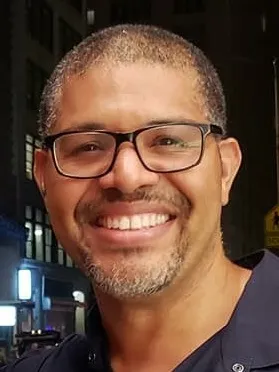
“I dedicated my life to being an educator as a result of my experiences at the Carnival as a student,” Ortiz said. “It opened my eyes to the broader impact of arts education. Later in life, I was diagnosed with dyslexia, which might have explained why school was challenging growing up, but the Carnival celebrated other aspects of my talents.
“It was a place where I developed my sense of self-worth. It was a place where I was successful and saw myself as someone who was making a contribution to the world.”
Beyond the Carnival, he has led and supported arts education initiatives at local cultural institutions, including Areytos Performance Works (which he co-founded), Henry Street Settlement, and The Bronx Museum of the Arts.
“I dedicated my life to being an educator as a result of my experiences at the Carnival as a student. It opened my eyes to the broader impact of arts education.”
From the Civil Rights Movement to the labor and economic justice demonstrations that shaped the early 1980s, the Carnival has a storied legacy of artists who produce work that is reflective of the times. While teaching at the organization, Ortiz’s workshops waded into candid conversations with youth and young adults about everything from environmental justice to gentrification.
“Looking at what was happening in the neighborhood and shedding light on it in some capacity has always been what the Carnival was about,” said Ortiz.
“It’s a true reflection of what’s happening on the street. When I was a Teaching Artist Intern at the Carnival in the early ‘90s, I remember talking about what came to be known as gentrification. At the time, we discussed the dichotomy of Uptown and Downtown neighborhoods—socially, environmentally, and economically.”
“Looking at what was happening in the neighborhood and shedding light on it in some capacity has always been what the Carnival was about.”
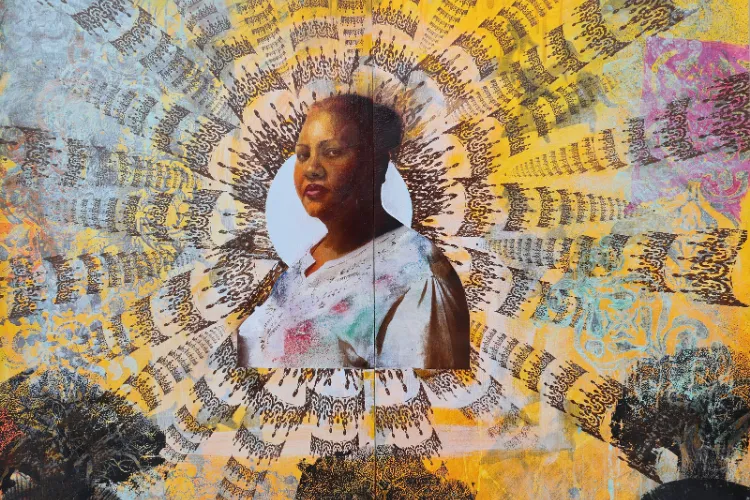
The inspiration for his Medusa Series, created in 2007, was derived from one of those thought-provoking discussions at the Carnival. The collection of mixed-media pieces on Masonite panels visually defies the historical characterizations of mythological and religious women who were deemed controversial, literally and figuratively painting them in a new light.
“The inspiration actually comes out of my teaching,” said Ortiz. “It came out of a conversation with my students in the early 2000s around femininity, cultural constructs, and different ideologies.
“Through the series, I wanted to center the matriarchal perspective rather than viewing these women’s stories from the patriarchal standpoint that society often tries to feed us. I wanted my students to know there were times in history—and even today—across different cultures and religions where women were at the center of their communities and informed how they grew and evolved.”
Among the women depicted in the series are Medusa, Mary Magdalene, and Meenakshi. Included in the collection of poignant portraiture is the artwork on display as part of Uptown Triennial 2026, titled Earth Goddess (Rafaela). The bold-hued multimedia work depicts Ortiz’s mother, Rafaela, and symbolizes her strength, leadership, and radiance.
Ortiz credits artists like Emmett Wigglesworth, whose work is also on view at the exhibition, and other mentors he’s had at the Carnival as sources of inspiration. One of the greatest lessons he’s learned from the Carnival’s founder, Betty Blayton, was the importance of taking a holistic approach to balancing his artistic practice and purpose in education. The way Blayton cultivated creative spaces for artists of all ages while still finding time for her own creative respite is something Ortiz thinks about often.
“I got to know Betty in adulthood, and something I think about almost on a daily basis was her selflessness,” Ortiz said. “She dedicated her life to creating this impactful space, and she was just as dedicated to her studio practice. That’s something I try to balance for my overall well-being. It brings me back to the thought of preserving yourself and taking care of yourself so you can support others.”
When it comes to what he wants individuals to walk away with after experiencing the Uptown Triennial exhibition, Ortiz hopes they gain a deeper understanding of what this unsung organization has meant for the local community.
“I truly feel the artists that have come out of the Carnival are very special individuals who have contributed to the cultural fabric of the neighborhood for many years and have never really been given a spotlight in this way,” Ortiz said. “I hope people who stop by are able to see themselves in the artwork. I hope it inspires them to visit the Carnival or another arts organization in the neighborhood to seek out a class or program. I hope it inspires them to feel more connected to the cultural institutions within their own community.”