'Upper Manhattan—That’s Home': Columbia Professor Hisham Aidi on Harlem's Influence on His Life and Work
"It’s this incredible confluence of music, spirituality, and politics," Aidi says.
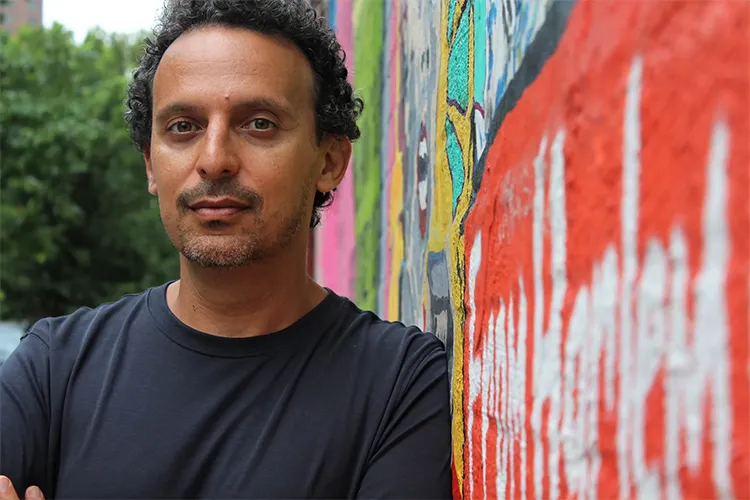
Hisham Aidi, Senior Lecturer in the Discipline of International and Public Affairs, has spent his life tracing the sound waves and indelible spirit of global Harlem all the way from his homeland of Tangier, Morocco, to Columbia University's Morningside Heights campus.
Aidi's Uptown connections run deep. He's a scholar of international relations, music, political economy, Black Studies, and postcolonial theory at Columbia's School of International and Public Affairs (SIPA). He serves as academic advisor to the Malcolm X and Dr. Betty Shabazz Memorial and Education Center, located at 3940 Broadway in Washington Heights.
But he's also a prolific author, journalist, and documentarian, with recent credits highlighting under-sung history-makers and subcultures, like Sister Aisha: Queen Mother of Harlem and The Original Halal B-Boy. Not to mention his erstwhile career as a radio DJ.
He recently sat down with Columbia Neighbors to talk about his early years in the city, the ties between Columbia and Harlem, and the rhythms that continue to move Upper Manhattan.
You were born and raised in Morocco. How did you end up in New York City, and what’s your relationship to Upper Manhattan and the Bronx?
Upper Manhattan—that’s home, I rarely leave it.
I first came to the U.S. for boarding school on scholarship, then college in Pennsylvania. But I was obsessed with New York: the radio stations, the music scene, the energy. I’d hitchhike up on weekends, record live shows and radio shows from WBLS on cassette and take them back to campus, where I couldn't get New York radio.
When I got into grad school, there was no question that I was coming to Columbia. Columbia’s in Harlem; it’s close to the Apollo, to East Harlem, to the Fania All Stars. I already felt plugged into the music.
What did those early Columbia years look like for you?
I was 21, maybe the youngest PhD student SIPA had ever had. I was a little lost those first years before the qualifying exams. I explored the city. I was DJing, coaching soccer, hanging out at WKCR and WBAI, and getting to know the radio and music community.
Radio was always central to me. Growing up in Tangier, we got stations from France, Spain, Gibraltar, Portugal. It’s how you learned languages, right?
When I got to Columbia, I lived at International House and ran the Harlem Tutorial Program, connecting kids from local public schools with international students for tutoring.
Around that time, I started working as a journalist, covering Harlem and the Bronx for a magazine called Africana. That became my beat: gentrification, migration, the arts. I wrote about jazz, Dominican music, and these amazing community organizers and writers like Herb Boyd and Glen Ford.
My favorite story was in June 2000, when I covered the funeral of Tito Puente: All these older Latin jazz musicians and Palladium dancers showed up to pay homage as Puente lay in state, and soon a dance party started across the street from the funeral home on Amsterdam Ave.
You’ve mentioned that you were drawn to the intersection of global politics and Harlem life.
Absolutely. I would cover the UN General Assembly from a Harlem perspective; how global leaders came Uptown, what that meant to local communities. Robert Mugabe [Zimbabwe's ex-president] came to pitch his land reform plan at Mount Olivet Baptist Church; I was in East Harlem in January 2000 when Jerry Rawlings of Ghana came and offered Ghanaian nationality to African Americans if they moved to Ghana; Fidel Castro spoke at Riverside Church. I remember Amy Goodman bringing in Chinese takeout for all the journalists waiting backstage.
So even back then, I was seeing international relations from below, from the grassroots. It’s something I tell my students: there’s the global South and the global North, and then there’s the global South inside the global North. The Bronx, Harlem, they’re global South spaces.
That perspective must have shaped your teaching.
Yes. I’ve always been fascinated by how people in the urban peripheries think differently about the world than people in policy schools. At SIPA, you’d hear realism, liberalism, but not much about Marxism or the Black radical tradition. Then you step outside, onto 125th Street, and you find Garveyites, the Nation of Islam, Puerto Rican and Dominican activists, all talking about decolonization and the UN.
It taught me that there’s elite international relations, and then there’s grassroots international relations—the intellectual trends and movements here in Harlem and the Bronx, which are informed by and linked to debates in the Global South. The links between the urban periphery and the so-called international periphery are very interesting.
How did you become connected with the Malcolm X legacy at Columbia?
As a grad student, I was floundering. Then I met Manning Marable, who was founding the Institute for Research in African American Studies (IRAAS) at Columbia. He was a giant in the field of Black Studies, and he had a decolonial approach to international relations, building on CLR James and Walter Rodney. He would say "let's start at the street level." He talked about studying hip-hop and reggae as ways of understanding politics. I told him, “I’m a DJ, I organize parties...can I sit in on your classes?”
He recruited me to work on three projects: the Malcolm X Project, a hip-hop archive, and research on the prison-industrial complex. That’s still what I’m doing today, in one form or another. I later became an academic advisor at the Shabazz Center, where we’ve been creating exhibits and trying to launch a fellows program.
You also work to preserve Harlem’s cultural archives.
So many elders here have these enormous personal archives: boxes of photographs, cassettes, vinyl, flyers, documents from the '60s onward. During the pandemic, Sister Aisha, who’s been organizing on Columbia's campus for decades, called to say she was moving to Atlanta. I said, “Before you put anything in storage, let me see what you have.”
It was incredible—decades of Columbia-Harlem history. We got the Union Theological Seminary to pick up her collection, and Hunter College to take the archive of radio host Ibrahim Gonzalez. There’s so much material out there, and Columbia should be helping to preserve it. Why did Harvard have to come down to New York to get Randy Weston’s archive?
We're now trying to find a home for the archive of Jackie Maclean, another Harlem-born jazz composer and musician.
Tell me more about your documentary work.
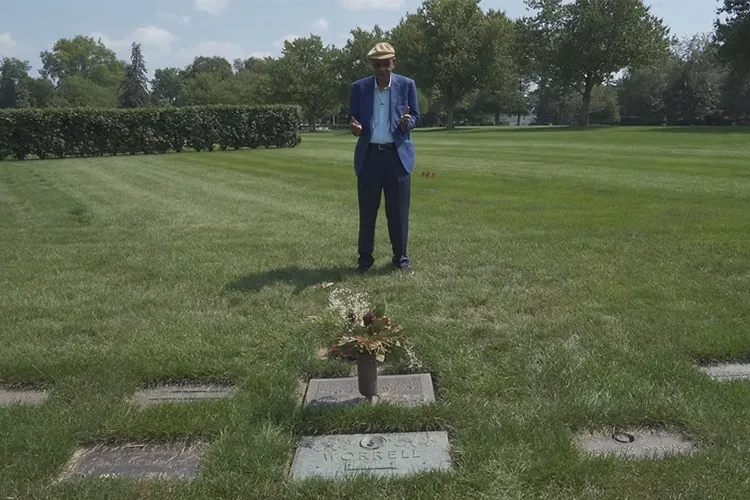
That came through my partner, who’s a visual anthropologist. I realized that a short film can reach more people than any article or book. One of my films, Malcolm X and the Sudanese, followed Ahmed Osman, who gave the eulogy at Malcolm X’s funeral, returning to Harlem 55 years later. We posted it just before the lockdown and got 20,000 views overnight.
Another documentary, A Thousand and One Berber Nights, tells the story of Hassan Ouakrim, a Moroccan choreographer who was brought to New York by director Ellen Stewart, who founded La Mama Theatre downtown. Ouakrim promoted North African dance and music in the theatre and jazz worlds; it's the story of migration and musical flows between New York and Morocco.
What’s it like teaching international relations in this city, specifically in Harlem?
Teaching IR in New York is not like teaching it anywhere else. Here, you have diaspora communities, people who are deeply connected to global struggles: Haiti, Palestine, Sudan. Harlem has always been a site of internationalism.
There's another woman whose archive I'm working on, Sister Rashidah Ismaili, who came to the U.S. in 1957 on a Fulbright to be an opera singer. She founded the first African Student Association in the country at Columbia.
Her living room was a center for anti-apartheid organizing. People would be at UN rallies by day, and at night would gather at her place. She also hosted the African Literary Salon of Harlem for decades, bringing great writers like Abdurazek Gurnah and Rajat Neogy. She's finishing her Harlem Trilogy now—she wrote Autobiography of the Lower East Side.
The way diasporas and language communities overlap in Upper Manhattan is striking. I remember one year how the Senegalese Bamba Day procession crossed paths with the Marcus Garvey parade on Sixth Avenue. The mix of Spanish and French layering atop Harlem's storied past is seriously postcolonial. Washington Heights is one of the largest Spanish-speaking neighborhoods in the country, and Harlem is today the largest French-speaking neighborhood in the US. The only other places where Spanish and French blend like this, I believe, is the Haitian-Dominican border and northern Morocco.
How does Harlem influence you personally?
You know, sometimes when I can’t sleep, I’ll just walk around Harlem—midnight, two, three in the morning. It’s beautiful, especially in the summer.
I remember being at the 50th anniversary of Malcolm X’s death in 2015. Herb Boyd, a prominent journalist and writer who knew Malcolm and mentored me when I was a journalist, organized it. He invited people who knew Malcolm to come up and testify. One woman said Malcolm was sometimes so angry he couldn’t sleep; he’d walk around, and people would just catch glimpses of him: the coattails of his trench coat disappearing around a corner. Such a beautiful image.
I think about that sometimes when I see people walking around at night. There’s this fascinating overlap between the people leaving the clubs (Red Rooster, the hip-hop and jazz spots) and those heading to early morning prayer. Around 4 a.m., you see people stumbling out of the clubs just as the older ladies in their hats are heading to set up church. It’s this beautiful meeting of the sacred and the profane that you only find in this neighborhood.
Around 4 a.m., you see people stumbling out of the clubs just as the older ladies in their hats are heading to set up church. It’s this beautiful meeting of the sacred and the profane that you only find in this neighborhood.
Upper Manhattan, Harlem especially, has an incredible density of faith communities. A friend once told me it has more churches per capita than anywhere except Jamaica, and that feels about right. My neighborhood has Hispanic evangelical churches right next to Francophone West African mosques. The interactions between them are so interesting.
A few weekends ago was Mawlid, the Prophet’s birthday. So you have all-night worship happening in the mosques of Harlem and the Bronx—the Francophone communities here, and across the bridge, the Anglophone ones: the Ghanaians, the Gambians. Meanwhile, the evangelicals are jamming with their guitars from Friday night through the weekend. It’s this incredible confluence of music, spirituality, and politics.
What are some of your favorite local spots, the ones you might share with students?
Showman’s was always my spot, a classic Harlem jazz bar on 125th, and Paris Blues, but I think they are now closed. There’s also American Legion Post 398, a veterans’ spot with jazz on Sundays.
Definitely check out Safari, the Somali restaurant on 113th and St. Nicholas. Or you can take the M60 bus to Steinway Street in Queens for the Moroccan food there.
I also tell students to go to the Shrine on Adam Clayton Powell Boulevard. We’ve watched the World Cup there for 20 years. It’s a hub: tea, music, people hanging out from all over Africa. They call that corner “the village.”
And of course, the Shabazz Center: that’s sacred ground. If you’re interested in hip-hop, Crotona Park is the place to see global turntablism in action.
What do you hope Columbia can do to deepen its relationship with Upper Manhattan?
Columbia should continue to invest in the community’s cultural institutions: support the Shabazz Center, provide scholarships, help digitize archives. There should be a Harlem archive at Butler Library. Students would love that.
Harlem is cosmopolitan. For newcomers, I always say: take an interest in old Harlem. Learn the history.
And to my students, I always say: walk north.