How Columbia’s Graduate Scholarship for Elementary School Teachers Propelled This Harlem Educator’s Career Pivot
The scholarship is awarded to current or future educators within Manhattan Community District 9.
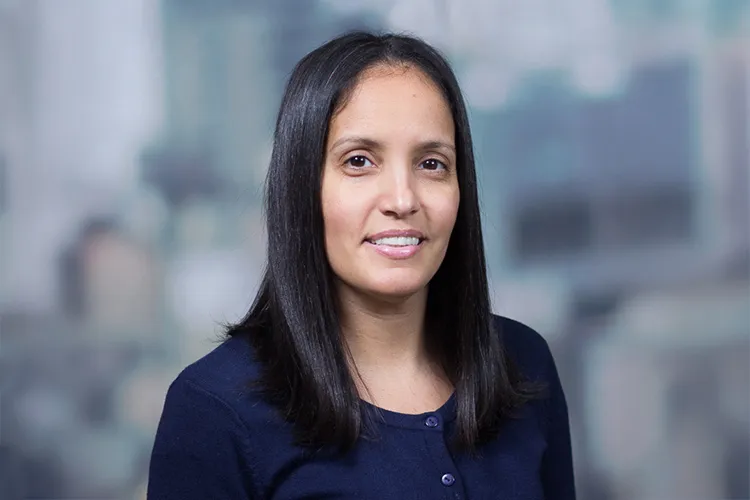
When Harlem educator Maria Franco’s world came to a standstill during the COVID-19 pandemic, the societal pause prompted a deep reflection on how to bridge her passion for education and her career. For more than two decades, she had championed education through her work in corporate philanthropy, but it was watching her 10-year-old son dive into digital learning as schools were closed that unlocked the potential of pivoting to teaching.
Through the support of Columbia University’s Graduate Scholarships for Elementary School Teachers program, Franco—who is now a fifth-grade teacher within Manhattan Community District 9—was able to bring her vision for making an impact through education to fruition. The scholarship, part of the University’s Community Benefits Agreement, is awarded by Columbia University's Provost to current or future educators within Community District 9, providing them with financial support to pursue master’s degrees.
The scholarship application is open to anyone who:
- is certified to teach elementary education in the State of New York;
- has been admitted or is pending admission to a master’s degree program at Columbia University or Teachers College;
- and is approved by the New York City Department of Education, the United Federation of Teachers, or their local school principal.
The program provides partial scholarships of between six and 18 credits per year to qualified elementary school teachers to support and enhance the quality of elementary school education within the local community.
Columbia Neighbors spoke with Franco, now a graduate of Teachers College, who received the scholarship by Columbia's Provost in 2024 and 2025, about how it bolstered her path in education, the advice she’d give to someone interested in applying, and using teaching to make an impact in the local community.
What inspired your pivot from corporate philanthropy to education?
I worked in corporate America for more than 25 years, leading and supporting philanthropic initiatives at JPMorgan Chase. About six years ago, when the COVID-19 pandemic hit, I reflected on the direction of my career and gained a clearer perspective on how I could connect what I’m passionate about to the work that I do. I always wanted to pursue education, but it didn’t seem realistic for me financially.
Visiting the schools and foundations we supported at JPMorgan left a huge impression on me. Watching my son, who’s now 17, make the pivot to online learning at home during the pandemic was also confirmation that stepping into education was the right move for me. It reaffirmed that I belonged in a classroom environment teaching other children like my son. All of these experiences influenced my decision to go back to school and get my master’s degree. My husband and son were supportive of me making the transition, letting me know you’re never too old to follow your dreams.
I decided to take the leap, submitted my six-month notice at work, got my first master’s degree in education at Hunter College, and then went on to get my second Master of Education at Teachers College through the Graduate Scholarships for Elementary School Teachers program at Columbia University.
How did you find out about the Graduate Scholarships for Elementary School Teachers program at Columbia, and what motivated you to apply?
After earning my degree at Hunter College, I didn’t feel like I was done learning. I felt like there was more I needed to learn as a teacher. About two years ago, I decided to go back to school. I live on the Upper West Side, and I didn’t want to travel too far since my son was in middle school at the time, so I looked for local schools to attend. After a few Google searches, I came across the scholarship program and thought it would be a wonderful opportunity. The commitment to staying in Manhattan Community District 9 after you graduate was something that really stood out to me. I was already teaching in Harlem Community School District 5 at the time, and I still am.
I was drawn to Teachers College specifically because of its strong focus on education and the opportunity to learn from other people who are really involved in the field. I also felt like I could bring what I was learning in the local community into my classroom, which would enrich the learning experiences for my students. My experience in the classroom made me want to teach on a deeper level and understand the elements that go into building an engaging curriculum. The scholarship allowed me to do that, and now I’m bringing everything I’ve learned back into my fifth-grade classroom.
How was your experience as a scholarship recipient?
Receiving the scholarship meant a lot to me because it felt like someone believed in me and the work I was doing as an educator. Sometimes it feels like once you’re in education, you’re stuck where you’re at and there isn’t any forward progression, but there are always opportunities to grow. It’s something I remind my students of every day.
Receiving the scholarship meant a lot to me because it felt like someone believed in me and the work I was doing as an educator.
Having the support of those who awarded me the scholarship and Teachers College felt personal, like there were people behind me. It wasn’t easy balancing being a mother, wife, teacher, and full-time student. Graduate school is not easy. I don’t know if I would have finished the degree if I didn’t have the support. I’ve been open with my students about my back-to-school journey in hopes that it will inspire them. I want to show them they’re never too old to learn.
As a teacher within District 5, what kind of impact do you hope to make in the local community through education?
It brings me back to my childhood. I grew up in Brooklyn between Flatbush and East New York. I’ve always remembered my first-grade teacher, Mrs. Villanueva. She was a huge influence for me because at the time, I didn’t have any Latina teachers. At that age, I would think to myself, “Wow, she looks just like my mom!” I think early on, without even realizing it back then, it showed me I could one day become a teacher too.
There’s power in representation and seeing yourself reflected in your teachers. I hope to inspire the students I teach. For me personally, being involved in the local community beyond the classroom is also really important. I always try to support what my students are doing outside of school, whether it’s attending one of their local dance shows or going to a festival they’re part of.
For me personally, being involved in the local community beyond the classroom is also really important.
I think District 5 is ready to do big things. Harlem is really strong. Where I teach is really strong. The district I’m in is really supportive, and I see that same sense of support at a broader citywide level. There’s always work to be done, but we’re making strides.
What advice would you give to someone who is interested in applying for the Graduate Scholarship for Elementary School Teachers?
I would 100% absolutely recommend it, not just for the financial support, but to know that as you start your journey, you have people rooting for you. Once I received the scholarship and started my studies at Teachers College, I knew it was bigger than me. I couldn’t let the people who invested in my education down. I wanted to prove I could do this and earn it. That motivated me to push through the program.
There was a sense of community among the recipients. I connected with two other teachers who received the scholarship before me, and they told me I would love being part of the program. It was great to see people who were awarded scholarships make it through their master’s programs, because it showed me I could do the same.
What’s on the horizon for you?
Now that I’ve graduated from Teachers College, I want to continue to explore opportunities in which I can incorporate what I’ve learned into the classroom. The impact of the scholarship didn’t stop when I graduated in May. In my eyes, the best way to honor the scholarship is to continue learning and make sure that my students benefit from what I’m bringing into the classroom. It’s not about the titles or degrees; I want to make sure I’m making a real impact on my students.