‘Home Is Here’: Buunni Coffee’s Journey From Addis, to NYC, to Columbia’s Medical Center Campus
Elias Gurmu and Sarina Prabasi, the founders behind local gem Buunni Coffee, spill the beans on two new locations on the CUIMC campus and what they are up to next.
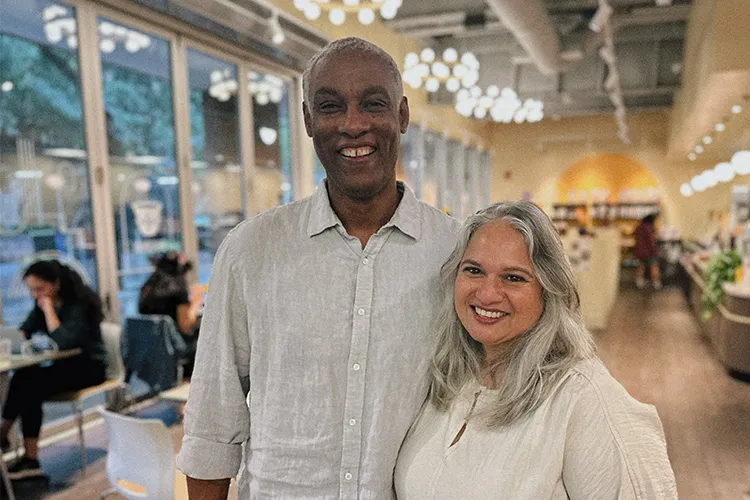
Fourteen years ago, Elias Gurmu and Sarina Prabasi had just opened a coffee shop in a tiny storefront on Pinehurst Avenue. They handed out samples at the Fort Tryon Park Harvest Festival, waiting for the moment someone would ask them where they could buy a bag of beans.
Today, their Northern Manhattan-based small business Buunni Coffee (a name based on the Amharic word for coffee itself, “buna”) has two locations (in Washington Heights and Inwood), coffee bags for sale at Trader Joe’s, a roastery in the South Bronx, and, as of this spring, a full-service café and grab-and-go coffee spot on Columbia University Irving Medical Center’s (CUIMC) campus.
Its location on Haven Plaza is open to the public at 711 W. 168th St., 7 a.m. to 7 p.m. daily. It’s location in the William Black Medical Research Building (open to CUIMC/NYP ID holders), 650 W. 168 St., is open 6:45 a.m. to 5 p.m. on weekdays.
“When Elias and Sarina came to campus for the tasting and interview process, it quickly became clear to both our team and the selection committee that Buunni embodied everything we were hoping to achieve,” said Dennis Scott-Torbet, director of CUIMC Campus Services. “They brought an outstanding product, deep community roots, and a mission that aligned closely with our vision of creating welcoming gathering spaces for students, faculty, staff, and neighbors.”
Columbia Neighbors recently sat down with Elias and Sarina to talk through it all: how they met, why Washington Heights, what kept them going through Hurricane Sandy and COVID-19, and what made Columbia the right fit for their newest locations.
Getting Into the Coffee Business
Tell us a little bit about your background.
Elias: I am originally from Ethiopia. I'd been doing a lot of entrepreneurial businesses back there: restaurants, car service, a pharmaceutical distribution company. Pretty much my entire life is in business. I was joking the other day, I never applied for a job, and I don't know how to apply for a job.
When did coffee enter the picture for you?
Elias: I had a restaurant-café business, back there also. But when we planned to move to the U.S., I wanted to do something related to Ethiopia. There's a lot of good things about Ethiopia, but to the outside world, coffee is one of the most famous things. It's the birthplace of coffee, on top of being the place where the first human being was found. Coffee is on that same level.
And Sarina, were you on an entrepreneurial journey that brought you to Ethiopia?
Sarina: I was the opposite. My whole career before Buunni had been in nonprofit: international development, health, education, safe drinking water. Through that work, I had been coming and going to Ethiopia. I did a maternity cover there for somebody, and then I was offered a job, and I really didn't even hesitate. I'd already fallen in love with the country.
I like to say I discovered coffee in Ethiopia, because I grew up in Nepal in a tea-drinking family. For us, coffee was Nescafé with milk and sugar. In Ethiopia I had my first cup of real, freshly roasted coffee, and I was blown away. There's a very vibrant café culture there.
I never heard someone say, “I'm going to have coffee.” It was always, “Shall we have coffee?” “We're having coffee; come with us.” Never an individual thing.
My office was in the neighborhood where Elias grew up in Addis Ababa. A colleague introduced us, and then I kept running into him. I honestly don't even know who said, “Let's have coffee.” But we did. The rest is history.
The Move to New York City
How did the journey to the United States happen?
Sarina: The first part of our life together was in Addis. We got married there in 2009. We had a really lovely life. At a certain point I felt like it was a good time to make a career change. We were both ready for a change. Elias decided on New York.
Elias: She shortlisted; I selected. We never really thought of it as a permanent move. It was “let's try this, let's see if we like it.” And we're still here.
When we moved, I took some classes, especially on how to operate a business in the U.S. There's a big challenge in understanding the culture, the language, and how you run a business. I spoke to people, we did research, and then we started.
Building a Business Through Neighborhood Connections
What was your first impression of New Yorkers' relationship to coffee?
Sarina: Coffee in New York was really the opposite of coffee in Ethiopia. When we lived there, there was no such thing as coffee to-go. It's not normal to take your coffee to go: where are you going in such a hurry? But what we found out after we opened our café is that people do want slow coffee. It's not obvious, because they're always in a hurry. But when you create a space where you can slow down, people embrace it.
“It's important to remember how grassroots the beginning was. It was the Harvest Festival, the Easter egg hunt, all of the community events in Washington Heights and Inwood. That really is the heart of the company still.”
Our first café was tiny, but somehow very warm, very neighborhood-y. There are regulars who know us better than some of our staff do, because they've been customers since the beginning, since we were doing coffee tastings at the Harvest Festival. It's important to remember how grassroots the beginning was. It was the Harvest Festival, the Easter egg hunt, all of the community events in Washington Heights and Inwood. That really is the heart of the company still.
What year did the first location open?
Elias: 2012. September 15. It's been 14 years. That was the year we had Hurricane Sandy, just about six weeks after we opened.
Sarina: We were packed. The subways were closed; people uptown had nowhere to go. We were swamped until we ran out of everything.
Elias: We closed after day three. No coffee, no milk, no deliveries.
Someone mentioned your second location opened very close to the beginning of the pandemic.
Elias: Yes. February 2019. We'd just celebrated our one year when COVID hit.
Sarina: We were supplying coffee to hospitals, to physicians. I don't even know how it started. It happened organically. Elias was doing deliveries. He was delivering to the emergency room at NewYork-Presbyterian Allen Hospital, CUIMC, Montefiore, the post office, police stations. Eventually customers started buying coffee and pastries and having us deliver them to essential workers. It kept us going, and it kept some of our staff going too.
Elias: Two locations reopened; two stayed closed. We were takeaway only for a long time. We made Ethiopian food and one of our staff put together a whole Ethiopian meal kit.
Sarina: It was a terrible time, but also a time of a lot of maneuvering and negotiating with landlords. We were lucky because we held onto most of our staff. We now have a core group of staff that has been with us for many years, some, for even more than ten years.
Growing the Team
How many staff members are with you now across all locations?
Sarina: Including the two of us, about 28 people, part-time and full-time. Opening this café on Haven Plaza and the one in the William Black Medical Research Building led to a lot of that increase.
How do you two hold the marriage and the business together?
Sarina: It's hard, and it gets harder as Buunni grows: what worked when we had four or five staff doesn't work with 28. Over the past year and a half, we've had a big focus on delegating, on growing the team from inside, giving opportunity to the people who've grown the company with us. We're literally fifty-fifty in the business, so if we disagree on something, there's no tiebreaker. One of us has to compromise.
Elias: We're trying to give people a way to grow inside the company. While working as a barista, someone might also be learning accounting, HR, social media.
Sarina: We have a longtime barista who's now certified in QuickBooks and is our bookkeeper.
The Columbia Partnership
Tell me how this all came to be: the new expansion, the partnership with Columbia. Who approached who?
Sarina: There was a very formal process, a request for proposals. But like most things, there was also a story behind it.
Elias: Since 2017, we've had anywhere between two and four locations at a given time. Right before this proposal came up, we'd actually decided to streamline. We'd just opened the roastery in the Bronx, and we didn't want to open a retail location unless it really fit what we were looking for. We'd closed our George Washington Bridge location. When this came up, we said, “Okay, this is one of the things we're looking for.”
Sarina: It made a lot of sense, but it was a stretch—there are much larger, well-established companies in institutional spaces like hospitals. We put our best foot forward. I remember saying to us internally: if the review committee wants to go in a more traditional direction, they're not going to pick us. But if they want to go with a local company, then it has to be us. When we were selected, it was a really big deal: for us, for our team, for everybody at Buunni.
“In the history of Buunni, this [partnership] is one of the biggest things that's happened to us.”
Sarina: In the history of Buunni, this is one of the biggest things that's happened to us.
Elias: We're a small business, but we're also at a stage where we choose where we want to work. When you're young, you rush—we're going to open here, we're going to do this. We're not in that stage anymore. We want to see what's right for us.
What made being right here attractive, beyond the obvious caffeine needs of sleep-deprived doctors and health professions students?
Sarina: The partnership with a key New York institution, and at the same time, still Washington Heights, to me, that was, wow, what a great opportunity. And it's within where we feel like we know. So many people who come here, or to the smaller location in the Black Building, were so happy for us because they know us. They work here, but they live there. There was also enough of that neighborhood feel already, plus relationships with nonprofits and arts organizations we've known a long time. And geographically, it's far enough from our other locations that it feels like a different part of the neighborhood.
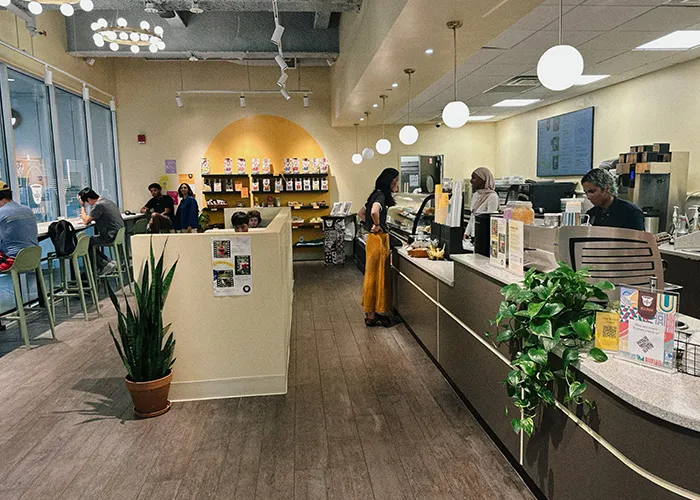
What vibe were you going for with this café?
Sarina: As part of the selection process, we had a tasting and interview, and I was surprised by how much the community aspect came up. The fact that we do events, that it's not just serving coffee. So now we've started a Sunday stage with acoustic music and a Spanish class. It's going to look a little different here, because we’re working with a big partner, but we're still advocating for bringing more art and more community activities.
The first priority was just getting the basic operations under our belt. We're really open to feedback. We might not be able to do everything, but some things we can start.
Elias: We're still learning about the audiences, the customers: what do they need? Every location has its unique needs.
Your Guide to the Buunni Menu
For folks who haven't been to a Buunni location, what are your three recommendations? Anything off-menu we should know about?
Sarina: I always recommend the Ethiopian macchiato. That's the drink we started with when we met and were getting to know each other. Don't expect a traditional macchiato: it's a little drink, it's potent, and it's also sweet.
If you're not a coffee drinker, don't be afraid to come here (we have tea too). And since we have our roastery, if you make coffee at home, buy your beans here. We'll grind them for you! It'll be much fresher than what you'll find in stores. There's also a loyalty program, and the points really add up. You could save up for a private barista class, or merchandise you can only get with loyalty points.
Elias: We serve one specialty single-origin coffee every month that's not on the regular menu. Right now it's a Dominican Republic light roast. It's a great gateway into specialty coffee because you're paying a drip coffee price for an amazing single-origin coffee.
Are the beans mostly Ethiopian?
Elias: Mostly, when we started, it was focused on Ethiopian coffees, but now we have coffee from the Dominican Republic, Honduras, Guatemala, Colombia, and Uganda.
Sarina: But most of our single-origin specialty coffees are from Ethiopia. There's a lot of diversity by region there. We visited almost all of the farms last summer.
Biggest Lessons Learned
Looking back at almost 15 years, what's the main thing you’ve learned about community or entrepreneurship?
Sarina: Go for it. That idea you have, the one that feels unrealistic but doesn't go away: go for it. One of the scariest things I've done as an adult was quit my job and join the business with my husband. A friend told me, “You're putting all your eggs in one basket.” I didn't do it right away; I kept working for a while as Buunni was being created. But yes, be smart about it, and also go for it.
Elias: Compared to 14 years ago, the opportunities are more accessible now. When we opened, there was no specialty coffee class in New York; I had to go to Oregon. We used to struggle to get pastry delivery and milk delivery up here. Getting baristas was hard too—most were in Brooklyn or downtown. So when we opened these businesses, including the roastery, we had to bring something here instead of always going down there.
What’s Next for Buunni Coffee
Anything else you want to share?
Sarina: We'll have a grand opening here at the new CUIMC café on Haven Plaza on Oct. 6: an Ethiopian coffee ceremony, games, raffles, prizes, tastings, music. We haven't had our official opening yet, so we wanted to do it right.
“It's really our community that has propelled us forward.”
I also want to make sure we convey the thankfulness we have for this relationship with the community. It's really our community that has propelled us forward. That includes our customers, our nonprofit partners, our staff, everyone who's been part of the story from tasting coffee at an Easter egg hunt to where we are today. Being a completely independent business is becoming more and more unusual, in the world and in the city. That's something we feel proud of, and we also feel a sense of responsibility to continue on that path.
Elias: Home is here.
Grand Opening Celebration Details
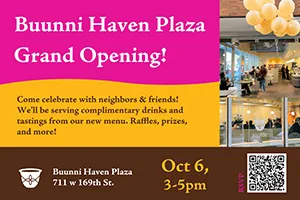
Oct. 6, 2026 at 3 pm.
Join Buunni Coffee on Haven Plaza at CUIMC for a grand opening celebration, open to all, featuring complimentary drinks and tastings from their new menu as well as raffles, prizes, and more. Learn more here.