Harlem Public Arts Project Celebrates Local History and Champions Communal Creativity
Founder Pierre Voltaire discusses how the project amplifies community voices through the arts, including exhibitions at Columbia University’s Bollinger Forum and collaborations with Columbia Engineering.
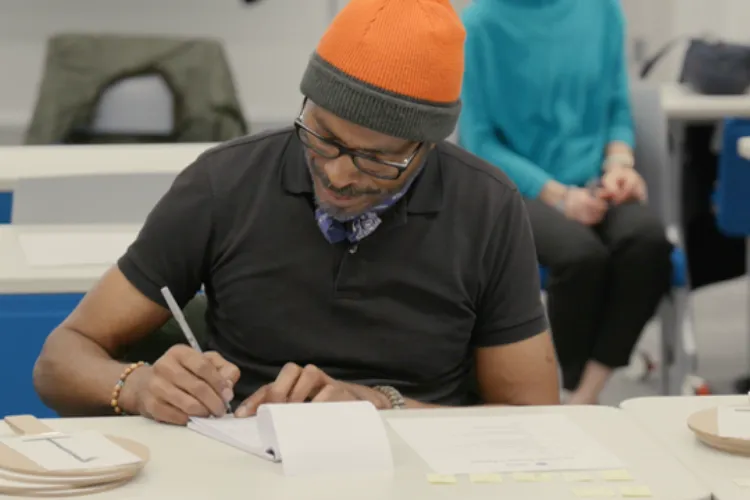
For Uptown native Pierre Voltaire, art is what binds communities together. Canvases are conduits for conversations, and murals are mediums for collective memory.
Throughout his journey, Voltaire—who grew up on the border of Harlem and the Upper West Side—has experienced the power of creative expression in many forms, whether it was through his childhood experiences in the performing arts, his career in fashion, or now as the founder of the Harlem Public Arts Project.
Through exhibitions at Columbia University’s Lee C. Bollinger Forum and participation in Columbia Engineering’s Center for Smart Streetscapes workshops, Voltaire is bringing community-driven art into conversation with the University’s and New York City's public spaces.
Launched in 2016, Harlem Public Arts Project's mission is to make the visual arts accessible, amplify the work of local creatives, and foster connections through creativity. The organization has created installations and exhibitions that add vibrancy to Uptown’s streetscapes. The projects, which often feature the collaborative work of artists and youth, serve as avenues to preserve the local community’s past and highlight the promise of its future.
Columbia Neighbors spoke with Voltaire about the nonprofit's vision, how art can serve as a form of cultural and historical preservation, and his community work beyond the arts.
When did you discover your passion for the creative arts?
I noticed the power of art at a very early age. I played the upright bass and piano, and I was in acting school. Aside from those things, growing up, I had a friend who was an even better visual artist than I was, and some of our classmates would pay him for his work. I thought it was so cool.
As I got older and spent more time in museums, I realized artists were creating something that no one could take away from them. For me, art became a form of empowerment: whatever I make is mine. You either like it or not, but it’s my art.
My early experiences have shown me why it’s important for youth to be exposed to the arts. If you can get up on stage and do a concerto, it feels earth-shattering, and you feel like you're on top of the world.
What inspired you to step into the arts space? What is the origin story behind the Harlem Public Arts Project?
The pivot came upon my return to Harlem about 15 years ago. After having a successful career in the fashion industry working for major labels, I was at a point in my life where I realized I wanted purpose, and I went on a journey to seek it. Between grade school and returning to the neighborhood as an adult, I had been to at least 30 countries and lived in four cities.
When I moved back to Harlem, I wanted to see what I could do in and for the community. I realized art was the sweet spot that spoke to what I had to offer.
I also wanted to create arts-driven intergenerational experiences because I feel like senior people in the community have a wealth of knowledge to offer young people, but with the rise in technology and social media, there is little communication and virtually no exchange.
I was at a point in my life where I realized I wanted purpose, and I went on a journey to seek it.
Before I launched the Harlem Public Arts Project, I worked on a series called Harlem to The Hamptons. I collaborated with a few friends in The Hamptons to host waterside art shows in Long Island, celebrating the work of Harlem artists. It lasted for a few years, and then I pivoted to the Harlem Public Arts Project.
I created the organization because I got tired of knocking on doors and explaining my vision for a localized public arts project. My biggest challenge navigating this space was trying to find a seat at the table, so I ended up creating my own. I figured if I built it, they would come. Whether through our community workshops, events, or public exhibitions, all my efforts in the local arts have focused on giving back.
Can you offer a lens into the nonprofit’s local impact?
Since the inception of the Harlem Public Arts Project, we’ve gained quite a following locally. We’ve done great things in the community and beyond. We were part of an award-winning documentary called Harlem to Haarlem as part of an international cultural exchange project. It was awarded at the Cork International Film Festival in Ireland.
We’ve partnered with local elected officials, organizations, and institutions like District 6 Council member Gale Brewer, City College of New York, National Jazz Museum in Harlem, Lt. Joseph P. Kennedy Jr. Memorial Center, The Fortune Society—where we offered arts workshops for the formerly incarcerated—the Harlem YMCA, New York City Department of Parks & Recreation, West Harlem Development Corporation, and the Lee C. Bollinger Forum at Columbia. I’m also a member of the Harlem Arts Alliance.
Most importantly, we’ve engaged with so many people from the community through our free and low-cost events. We've hosted everything from an Arts in the Garden series with live jazz and painting to finger painting workshops for kids. We have supportive people from the neighborhood, and a collective of artists who come out to our events.
Creating the Harlem Public Arts Project has shown me that if you do things with the right intentions, the community will reap the benefits.
How did you get connected with Columbia University and the team at the Lee C. Bollinger Forum?
In 2018, we did a project with the Boys and Girls Club of Harlem and the Manhattan Educational Opportunity Center which is housed inside the Adam Clayton Powell Jr. State Office Building. The students worked with us to create a couple of murals on canvases. Out of that collaboration came two very large paintings honoring the legacies of Rosa Parks and Angela Davis.
Initially, they were displayed in the Cathedral of Saint John the Divine’s art gallery for Black History Month. Both pieces were slated to go to the National Museum of African American History and Culture in Washington, D.C., before the COVID-19 pandemic, but ended up sitting in storage for a while as the world grappled with the health crisis.
I started to look for local places where the artwork could be displayed, and someone connected me with Kim Milián, the Director of Events and Special Projects at The Forum. I gave her a proposal, and she allowed us to have the exhibit. It was titled Icons of Activism and ran for about 8 months in 2023.
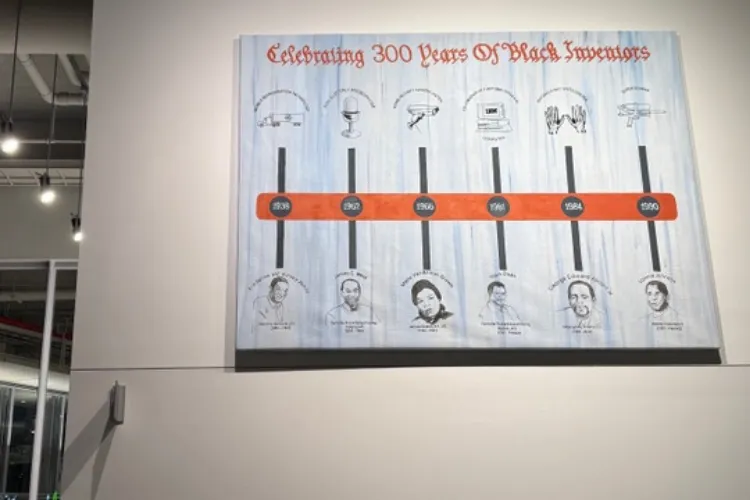
That initial project opened the door for the Celebrating 300 Years of Black Inventors exhibition, which I created solo. I rolled up my sleeves, built the frame, stretched the canvas, and created the artwork. The mural visually celebrated the innovation of Frederick McKinley Jones, James E. West, Marie Van Brittan Brown, Mark Dean, George Edward Alcorn Jr., and Lonnie Johnson.
The Forum is the ideal space because it aligns with the core of everything we do, which is to create things that are public and accessible.
The beautiful thing about The Forum is that it’s public. You could sit there at no cost. You can look at it from the outside as you're walking. That's beautiful. I totally appreciated the opportunity to showcase the pieces at that location.
The Forum is the ideal space because it aligns with the core of everything we do, which is to create things that are public and accessible.
We've also created other murals in the neighborhood. A few blocks away from The Forum, near Dinosaur Bar-B-Que by the loop where cars exit the West Side Highway, we have a mural that every graffiti tagger respects.
We collaborated with a local church for that project. It really speaks to beautifying the community. We’re always looking for ways to engage through art.
What was the inspiration behind the two Harlem Public Arts Project exhibitions at The Forum?
It’s this idea that we’re in a space in society where history is currently being rewritten. It’s happening as we speak. The history books are being changed. There are intentional revisionists. The work we do at the Harlem Public Arts Project is all about letting young people and the people who might want to keep them down know about the true history.
I put so much emphasis on empowering the youth because it’s important they know their history. We want to show them they come from a group of people where successes don’t only lie in entertainment and sports, and we should continue to have that conversation. I want to show them that it’s upon themselves to chart their own paths and write their own stories, and we use our arts projects as spark plugs.
The youth will be okay, as long as they have the tools needed to look forward. My philosophy is that if you do good, you’ll be good.
How can art be used as a form of cultural and historical preservation?
Artwork serves as a reminder and reference point that can remain in an ever-changing community, illustrating who occupied these spaces or what existed there. Architecture speaks to that. Art speaks to that.
From the beginning, we focused on murals and public art, and we initially started a visual arts campaign highlighting iconic African American heroes of the past and present through imagery and quotes throughout Harlem.
We wanted the murals to be around when people came to Harlem as a reminder of different chapters of history. We wanted to create things that were informative and educational.
Our recent exhibition at the Lee C. Bollinger Forum, Celebrating 300 Years of Black Inventors, carried that same narrative. The exhibit spoke to the community. Through our work, we always strive to find artists who can continue the conversations through their creations—because there’s plenty to talk about.
Artwork serves as a reminder and reference point that can remain in an ever-changing community, illustrating who occupied these spaces or what existed there.
You were also recently part of Columbia Engineering’s Center for Smart Streetscapes workshops. What inspired you to get involved, and how was your experience?
I’ve always had a passion for art and technology. A while back, I partnered with Silicon Harlem to do 3D printing workshops for youth in the local community. I also connected with Melvin McCray III—who founded the Digital Media Training Program in Harlem and taught at Columbia Journalism School—and we collaborated on a few projects that combined art and tech. Through meeting him, I started going to community events at the Lee C. Bollinger Forum, and about four years ago, I attended a panel about how to use technology to make the lives of Harlemites better.
It was there that I connected with a few folks from Columbia, and about a year later, I received an invitation to be part of the Center for Smart Streetscapes workshops. During the workshops, we worked on an app designed to improve traffic safety. We came up with concepts around where we would position traffic units and how we would collect data. The group was made up of people who worked across different industries and lived in the local community. Since then, I’ve participated in about five workshops.
When I joined the workshops, I initially didn’t know what to expect, but seeing people who have knowledge of the community work together to create something that could help people live better lives was great. The mechanism we were building was serving a good purpose.
What is on the horizon for you and the Harlem Public Arts Project?
With the support of the New York City Department of Parks & Recreation, we have an upcoming event on Saturday, April 25, from 10:00 AM to 2:00 PM. It will be a Community Fun Day where young people and seniors will work together to plant trees and flowers while helping clean up the park. There will also be arts and crafts activities for families, along with plant giveaways.