In Its Third Year, Here Are 5 Pieces in the ‘Harlem Sculpture Gardens’ You Need to See Now
Savona Bailey-McClain, executive director of the West Harlem Art Fund, shares how the public art exhibition came to be and where to see it all this summer.
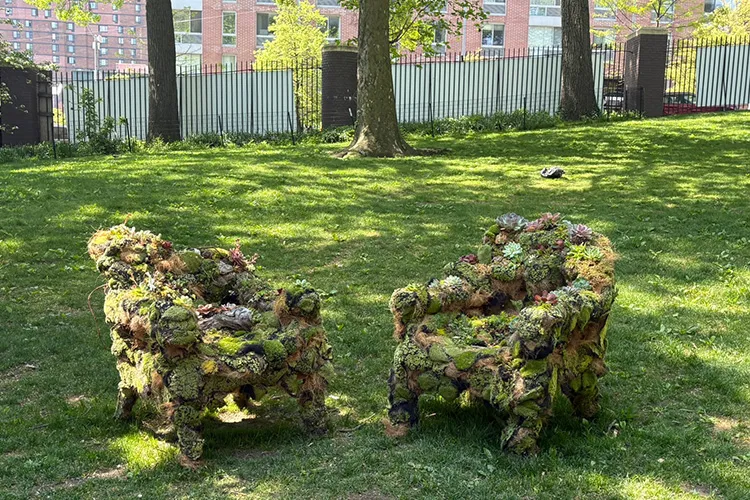
When she was just nine years old, Savona Bailey-McClain went to the Metropolitan Museum of Art for the first time on a field trip with her elementary school in the Bronx. She vividly remembers her mother tenderly loaning her a scarf and special pin for the trip. When she got there, everything changed: seeing and thinking about art became core to her identity.
Decades later, as a young woman settled in Harlem and working full-time at a mental health clinic for children, still taking every chance she got to immerse herself in the art world, she noticed something: People she met every day felt shut out by museums and galleries, intimidated before they even reached the front door.
“I never could quite understand why people were so intimidated,” Bailey-McClain said. “It is a very American problem, and I just said, ‘What if I helped to bring art into the open public space where people could see it every day?’”

So she started asking questions: What if art just lived on a walk to work or at the entrance to church? No admission required, no expectations, no judgments.
Those questions became the West Harlem Art Fund, founded on Jan. 1, 1998. She built it from the ground up, learning everything about art curation on the fly—contracts, insurance, networking, archives, installation, the administrative work of a nonprofit. Her first project, a mural proposal for a Hamilton Heights playground, didn't get funded, but it did grab the attention of The New York Times, which wrote about it before she'd even built it.
Four years ago, that same instinct (to go for it, to put art where people already are, and learn how to do it yourself) scaled up into Harlem Sculpture Gardens, after Jana La Sorte, the then-administrator of Historic Harlem Parks, tracked Bailey-McClain down where she was working on Governors Island and asked if she'd consider mounting a large-scale exhibition Uptown.
She said yes, making the deliberate design choice to craft a linear route from Morningside Park, to St. Nicolas Park, to Jackie Robinson Park, west toward Montefiore Square and Broadway Malls, so visitors could walk from one sculpture to the next, park to park, with each piece placed for maximum visibility along the way.
Bailey-McClain is intentional about the medium, too. She avoids murals now, she said, in part because they can be painted over and because public art commissions for artists of color skew heavily toward murals, which don't carry the same permanence as sculpture. There's a lot of work to be done in New York, and particularly in Upper Manhattan, to support affordable fabrication spaces for artists as well.
In 2024, the first installation took place, in collaboration with the New York Artist Equity Association, NYC Department of Parks and Recreation, as well as local community boards and neighborhood groups (including Columbia's Office of Government and Community Affairs). This year marks its third installment, and for Columbians, there are six sculptures located a hop, skip, and a jump from campus in Morningside Park. A perfect lunchtime stroll, if we do say so ourselves!
This year's route includes work from artists who have become fixtures of the exhibition alongside newcomers, and will run through Oct. 30, 2026.
Here are just five of the pieces you should make a point to walk by this summer and early fall, but make sure to bookmark this map, where you can find all 21 sculptures this year:
Sagittarius | Morningside Park
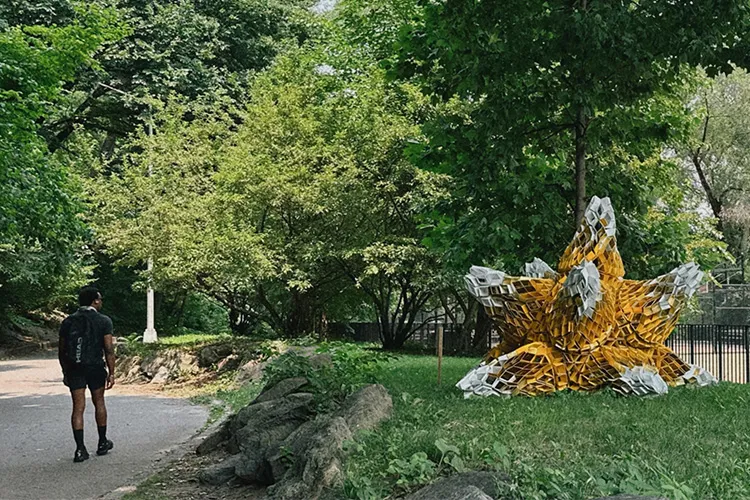
Peter Miller (GSAPP'06), a Columbia University graduate and architect who has shown pieces all three years, returns with Sagittarius, an aluminum piece in Morningside Park built using an origami-based fabrication process—folded rather than welded, with seven different fabricators working on it at any given time.
Afro Puff | Morningside Park
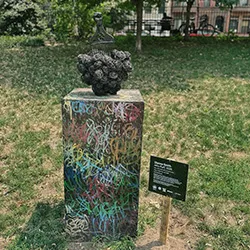
Harlem-based artist Dianne Smith, also a three-year veteran, contributes Afro Puff, which stacks two eras on top of each other: a graffiti-tagged pedestal evoking the '80s and a '70s Afro pick that she worked with City College's engineering school to 3D-print for the piece.
Twilight | Morningside Park
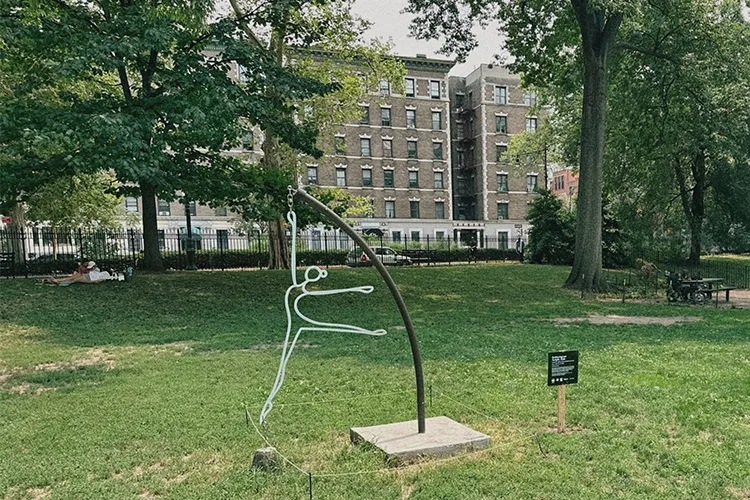
Eunkyung Lee's Twilight is a kinetic piece that translates choreography into steel, moving with the wind and glowing in the dark.
Beacons on the Lawn | James Baldwin Lawn, St. Nicholas Park
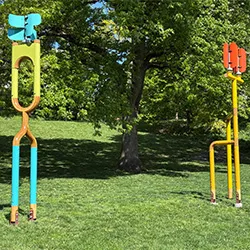
Designer and educator Chris Sandcomb's wind turbine-inspired sculptures use a deliberate color palette so viewers can track their motion as they turn.
Offspring | Jackie Robinson Park
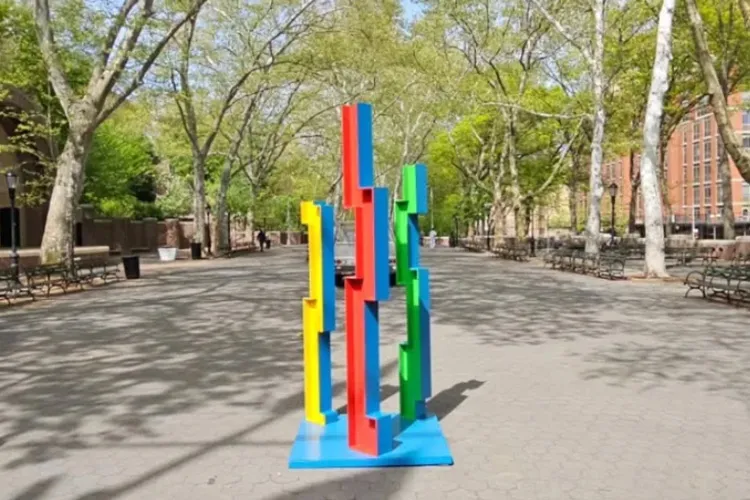
Edwin Salmon's 700-pound piece anchors the northeastern end of the route and is definitely worth the walk to see its scale up close!
What's Next for the Harlem Sculpture Gardens
Somewhere along the journey to creating Harlem Sculpture Gardens, Bailey-McClain started noticing soil erosion and flooding in Morningside Park, where trees more than 75 years old were toppling over and standing water gathered after storms. During one heavy spring rain, she found herself standing in floodwater near a newly installed sculpture. She filmed the water and sent it to City College's School of Architecture, and faculty members confirmed what she had already started to suspect: soil erosion tied to climate change was the culprit.
That observation has since grown into a formal, multi-institutional effort to fight back: Bailey-McClain is now working with City College and Columbia Climate School on a “land, water, and air” monitoring plan, adding drone-based aerial monitoring and a river group teaching novice paddling and citizen science on the Harlem River. She's also training as a pathkeeper for Highbridge Park, as the sculpture route expands there next year. Columbia affiliates recently joined walk-throughs of the old Aqueduct Trail near the High Bridge, with drones in tow.
This approach is indicative of Bailey-McClain's resolve to never stop learning. In her mind, climate change mitigation in our parks ensures that art can be displayed in them forever. And forever is part of the plan as the Harlem Sculpture Gardens exhibition continues to grow.
“Growth comes from connection, and our strength is in our diversity.”
This year, a partnership with Link NYC gave the West Harlem Art Fund free nonprofit digital advertising across all five boroughs, and the Harlem Sculpture Gardens drew more than 800,000 impressions alone. Press coverage has included CBS, ABC, Hyperallergic, Art Daily, and Time Out New York.
But Bailey-McClain measures success differently: in the moments on her own block, when neighbors stop to say they saw her on television, and ask not about her, but where they can find the sculptures this year. One of her fondest memories is of a young boy during the exhibition's first year who was convinced the sculptures were alive and asked her every time he saw her: “Are you going to check on them now?”
None of this happens quickly, though.
“This is not instant,” Bailey-McClain said. “A lot of time, a lot of planning, a lot of thoughtfulness in our present day where everything is so instant. People tend to think this can be done just like that, and it's not.”
It's part of why she keeps pushing her work to include unfamiliar traditions and new techniques.
“Growth comes from connection,” Bailey-McClain said. "And our strength is in our diversity.”
The Harlem Sculpture Gardens pieces are on view until Oct. 30. More information is available at harlemsculpturegardens.com; donations can be made at westharlem.art.