Building Opportunity From Within: Ray Tebout’s Path as a Bundles Community Scholar at Columbia
This A'Lelia Bundles Community Scholar has used Columbia University's classrooms, connections, and intellectual camaraderie to refine a concept he calls “Vision to Value.”
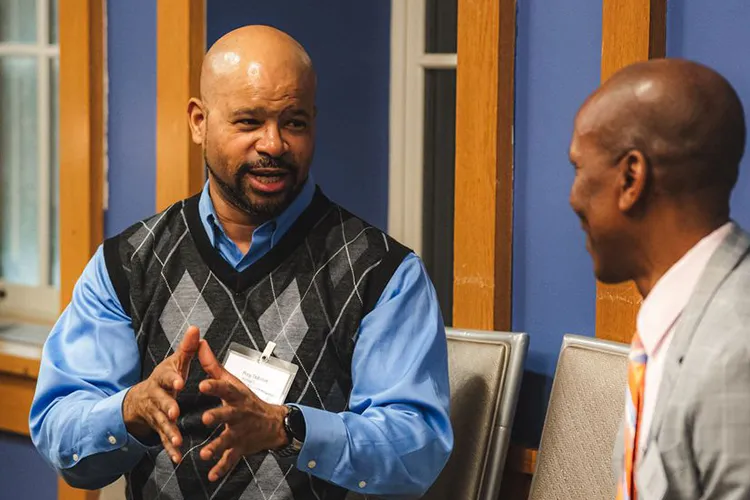
Ray Tebout has a knack for translating big ideas into practical tools that help people thrive at work and in their personal lives. As an A’Lelia Bundles Community Scholar, he has used Columbia University’s classrooms, connections, and intellectual energy to refine a project he calls “Vision to Value,” which combines project leadership, personal behavioral reflection, and intrapreneurship to create business value.
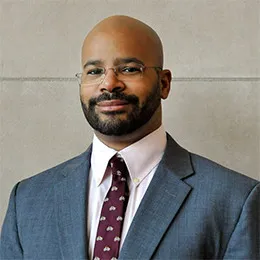
His path to this work is rooted in lived experience, including personal and professional interactions with the carceral system, the nonprofit sector, and private consulting that shaped how he thinks about leadership. He pairs this experience with the perspective of something many of us hear about every day: project management.
But how many of us really understand it as a way to shape the mind and achieve our dreams?
“I got curious about the concept when I was working in college administration, running a program with 600 incarcerated students seeking degrees,” Tebout said. “Each of these students were working toward an end goal (a value-adding degree), and I was orchestrating the communication, resources, and complex stakeholder relationships to help them achieve their goals. The definition of project management."
Today, Tebout is a veritable dynamo, holding trainer-level credentials in human resources, project management, and addiction treatment. He serves as an Executive HR business partner at a major New York City reentry organization and leads MindFrame Talent Development Solutions, where he helps organizations build talent pipelines and strengthen workforce performance. He also serves on the boards of The Fortune Society and the Petey Greene Program.
Tebout recently sat down with Columbia Neighbors to talk about how his experiences connect to his work today, how the Bundles program supported his evolution, and what he’s learned along the way.
You are considered an exemplar of the A’Lelia Bundles Community Scholars Program. How did you first get involved with it, and what have you found most valuable so far?
First, I just want to say I’m really flattered that people think so highly of me. I always feel like I’m fumbling around in the dark and reaching for handholds, but I’ve learned that’s not always how other people see it.
For me, one of the biggest things has been the classes. Not just the classes, but the atmosphere. Being able to go to a library, be on a campus, and be around a bunch of smart people doing smart stuff is huge. I jokingly call it “osmotic enthusiasm.” You’re just in rooms full of people who are thinking and talking about ideas.
Work is often a place where smart people are forced to dumb themselves down to get things done. Being at Columbia is different. The students bring these rich, diverse experiences, and the professors and guest speakers bring incredible knowledge. It inspires me to want to learn and explore. To be curious even more than I already am.
It also puts you in rooms you wouldn’t normally be in. I wouldn’t necessarily be in conversation with a tech executive or someone leading AI marketing in my everyday life, but suddenly there’s a reason for us to be talking. That kind of access acts like an accelerator.
"Work is often a place where smart people are forced to dumb themselves down to get things done. Being at Columbia is different. It inspires me to want to learn and explore. To be curious even more than I already am."
What project did you initially bring into the program?
Initially, I wanted to focus on people who were stuck in middle management, particularly in mission-driven or nonprofit organizations, and help them get past the barriers they were facing. Through research and experience, I expanded “Vision to Value” to meet participants at each stage of the talent pipeline—not just middle management. My platform has always been around intrapreneurship: creating businesses or initiatives within other people’s organizations so you can have autonomy and agency while also generating value.
The crux of it is this idea of “own your job.” Be seen as a business partner instead of just an employee. But that also has to be earned. You need business acumen. You need to speak the language of the organization and align yourself with its vision and with the people who are driving it.
That way of thinking comes directly out of my own experience. There was a period in my life when I had to decide whether I was going to let my circumstances define me or whether I was going to figure out what I could contribute wherever I was. That question, “What value can I add here?” has stayed with me ever since.
How did that idea evolve into what you now call ‘Vision to Value’?
What I realized over time is that people often have great ideas, but if they can’t translate those ideas into something an organization understands and values, they get frustrated. Then it becomes, “My boss doesn’t understand me,” or “I’m unappreciated here.”
So “Vision to Value” is about taking an idea and moving it from concept to something that actually adds value to the organization and aligns with its mission and priorities. It’s about understanding that there’s the big-picture vision an organization talks about, but there’s also a person driving the bus, and they have their own concerns, detours, and constraints.
The goal is to help people bridge that gap: to not just have ideas, but to be able to make the case for them in a way that decision-makers can hear.
Where did project management fit into this work?
Project management gave me a structure and a language for things I was already doing. It provides a way to take an idea from beginning to completion. I think of it as “vision to value” in practice.
A lot of people already have the skills; they just don’t have the taxonomy or the framework. Once you give people that structure, it becomes less intimidating. Suddenly, they can see how an idea becomes a project, how a project becomes a deliverable, and how that deliverable creates value.
Part of my training model is to prepare people to learn a skill and earn a globally recognized industry certification, Project Management Professional (PMP), the way I did.
That’s especially powerful for people who haven’t always had access to formal credentials, because it gives them something concrete and transferable.
How did your Columbia coursework influence the way you shaped the project?
The classes really reinforced for me that complex things don’t have to be inaccessible. One of the most impactful experiences was a project leadership course at the School of Professional Studies helmed by Gregory Robinson that used NASA as a case study. We looked at how massive, high-stakes projects actually get done—how you break something incredibly complex down into clear roles, timelines, and decisions.
That class made it obvious to me that leadership isn’t some abstract, heroic thing. It’s practical. It’s about systems, communication, and responsibility. If NASA can take something as complicated as space exploration and manage it through disciplined project leadership, then those same principles can apply to much smaller, everyday organizational challenges.
That experience pushed me to think, “okay, I need to do this too.” I need to explain things in a way that people can actually use. Not theory for theory’s sake, but tools people can apply immediately in their real lives and jobs.
How does your lived experience inform the work you’re doing now?
I entered the criminal legal system as a tired, bored, angry, scared kid in a hostile adult environment. During orientation, someone said something that stuck with me: “You can either do your time, or you can let your time do you.”
That became a turning point for me. I started by asking, “when do I get out of here?” Then I moved to, “what can I get out of this?” And, eventually, “what can I contribute while I’m here?”
Once that mindset shifted, everything changed. When I came home, I carried that same philosophy with me: not just what can I get from this situation, but how can I leave this place better than I found it?
"I want people to understand that entrepreneurship isn’t the only path to freedom or agency. Not everyone has the luxury of taking unlimited risks. Most people need stability, accountability, and a paycheck."
What do you hope your work ultimately offers to the community?
I want people to understand that entrepreneurship isn’t the only path to freedom or agency. Not everyone has the luxury of taking unlimited risks. Most people need stability, accountability, and a paycheck. Intrapreneurship offers many of the same rewards of external business ownership but with an employer sharing the risk and rewards.
Learning how to own your role within an organization, how to align your skills with its mission, can give you autonomy, purpose, and room to grow without taking on risks that could jeopardize your livelihood.
That focus on contribution, on asking “What can I add here?” is something I learned out of necessity. It’s at the core of everything I’m trying to pass on now.
Vision-to-Value: Moving the Justice-Impacted Workforce from Individual Talent to Business Partnership
March 25, 2026 | Lee C. Bollinger Forum Atrium
Hear Ray Tebout share more about “Vision to Value” during the next A'Lelia Bundles Community Scholars Lecture.
Learn More
You can also learn more about the A'Lelia Bundles Community Scholars program and stay tuned for updates about the next application cycle here.