Sowing Seeds of Community Care at Harlem’s Saint Nicholas Miracle Garden
The reimagined green space has become a beacon of education and empowerment in Central Harlem.
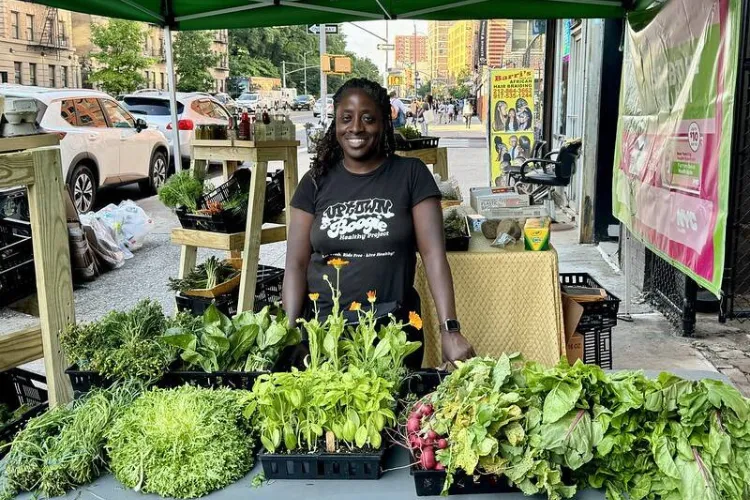
Nestled along one of Uptown’s bustling corridors, the Saint Nicholas Miracle Garden is shaped by legacies of community care that stretch from Harlem to Haiti. In 1958, a group of children who attended the now-shuttered P.S. 157 public school across the street transformed the once-abandoned lot into a thriving garden lined with vibrant marigolds and zinnias as a symbol of community pride.
Despite their beautification efforts, as the neighborhood’s landscape shifted, the space fell back into a cycle of disinvestment until Brooklyn native Judi Desire saw its potential for revitalization.
In 2021, inspired by her family’s community-driven approach to horticulture in Haiti, Desire launched its revival through her nonprofit Uptown & Boogie Healthy Project. The organization advances food justice and sustainability efforts Uptown through immersive education programs and affordable farmers markets.
Columbia Neighbors spoke with Desire about the initiatives at the St. Nicholas Miracle Garden, the current state of sustainability in New York City, and the importance of green spaces Uptown.
At what point along your journey did you develop a green thumb? Were there horticulturalists in your family or local community?
I’m a first-gen, so sustainability and environmental impact looked a little different to me growing up in the city. My mother and I would go to Haiti—where my family is from—for vacation, and the agricultural landscape looked totally different from where I was born and raised in Brooklyn.
In Haiti, I’d see my aunt growing medicinal plants for the community and caring for livestock in her backyard. She would take food scraps and put them by the medicinal trees to use as natural fertilizer—and that was composting. What I was seeing was sustainability in action without even truly knowing what it was. There were never any conversations about it. I watched my aunt grow, my mother kept plants in the house, and all the women in our family had green thumbs. It was part of our family’s tradition to grow, give, rinse, and repeat.
It wasn’t until I entered college that I really started to learn about the terms associated with environmentalism. I pieced everything together as an adult. When my mother and I moved from Brooklyn to Queens to stay with another aunt, I developed a love for growing. She had a front yard, and I would grow tomatoes, sunflowers, and other plants.
I didn’t realize it at the time, but I was companion planting. Sometimes my plants and vegetables would go missing, and I later discovered that a squirrel (and a neighbor) were the culprits. But one thing my mother always instilled in me is that the purpose of growing is for other people to eat.
Growing up in Brooklyn, were there any local green spaces that you frequented?
Green spaces were almost nonexistent. I lived near Grand Army Plaza; however, I didn’t really explore it until I was an adult and got into biking, because back in the day, it wasn’t the safest place to be. As a child, most of the playgrounds we went to were attached to schools, not parks. The only green spaces I knew about were outside of New York and back in Haiti.
As I’ve gotten deeper into the gardening space and started to dive into the history of community gardens in New York City, I was surprised to learn they were around back in the 1970s. No one came to my neighborhood or school to talk about community gardens. There was a lack of awareness. It wasn’t until we had that short stint in Queens in Mitchell-Lama housing when we saw gardens and growing right in the community—but even then, there was limited access.
What is the inspiration behind the creation of the Uptown & Boogie Healthy Project? What led you to plant the roots for the Saint Nicholas Miracle Garden and the Uptown Good Food farmers markets in Harlem specifically?
There are many sources of inspiration. I moved to the border of Harlem and Washington Heights in 2006, and one of the things I loved about Uptown was the environmental landscape: all of the parks and the ability to walk along the Hudson River. It dawned on me that Manhattan is a literal island.
By the time I got the space for the Saint Nicholas Miracle Garden in 2021, I was navigating a lot personally. My mother, who was still living in Queens, was in her final stages of Alzheimer’s and dementia. I had known healthy eating slowed down the progression, but later, while caring for her, I learned gardening could too. It made me wish I had the garden earlier because getting her more access to greenery and a space where she could do what she loved—growing—would have been beneficial for her.
Through my experiences as a caregiver for my mother, after she was officially diagnosed in 2013, I started to recognize the lack of regard for senior citizens across different spaces. Spaces for seniors would turn her away once I shared her diagnosis. I fought for everything: her health benefits, a home aide, medication management, and commuting back and forth from Manhattan to Queens—while still working—to make sure she was taken care of. I did it alone as an only child. I often wondered, "Where is there a space for my mother?" "Where is there a space for me?" It was polarizing. Since then, things have changed, and there are more resource groups and people you can talk to, but I still believe there needs to be more support.
Through it all, I developed a more profound passion to advocate for seniors and their caregivers, and that’s one of the inspirations behind the Uptown & Boogie Healthy Project and our initiatives, which include the Saint Nicholas Miracle Garden and the Uptown Good Food Farmers Markets in front of St. Nicholas Park. I make sure seniors know about all the benefits they can access—some of which I didn’t know existed when caring for my mother. They can get fresh foods from our farmers market through the Farmers Market Nutrition Program's senior discount, and I’m currently trying to get OTC benefits accepted at all our farmers markets.
Part of my outreach involves visiting senior centers throughout the local community to spread awareness about these programs and encourage seniors to stop by the garden and our markets.
I developed a more profound passion to advocate for seniors and their caregivers, and that’s one of the inspirations behind the Uptown & Boogie Healthy Project and our initiatives.
Another source of inspiration is creating access to sustainability education for local youth. I grew up not knowing much, and I don’t want it to be the same for the next generation. We have programming at the garden and our farmers markets to teach kids about healthy foodand help them better understand things like composting. The space where the St. Nicholas Miracle Garden is now used to be a children’s garden for students at the now-closed P.S. 157 across the street decades ago. We brought it back as a learning space for children.
The final source of inspiration for the organization came from conversations I had with local cyclists after I got into biking. I learned how to ride in 2010, and started Uptown & Boogie Bicycle Advocacy because there was a lack of biking groups in Upper Manhattan. Every conversation I heard about biking was below 110th Street, and Uptown, there were no discussions about the health and economic benefits of biking. A lot of the people I would ride with shared concerns about the lack of access to fresh food, and I wanted to support them and the community at large, so we transitioned the organization into the Uptown & Boogie Healthy Project.
We currently have farmers markets in both Harlem and the Bronx, and we want to bring more programming to those areas. I think there’s a lack of conversation—especially at the local representative level—about seniors, kids, food access, and biking. Even though the infrastructure is much better than it was in 2010, there’s still room for improvement.
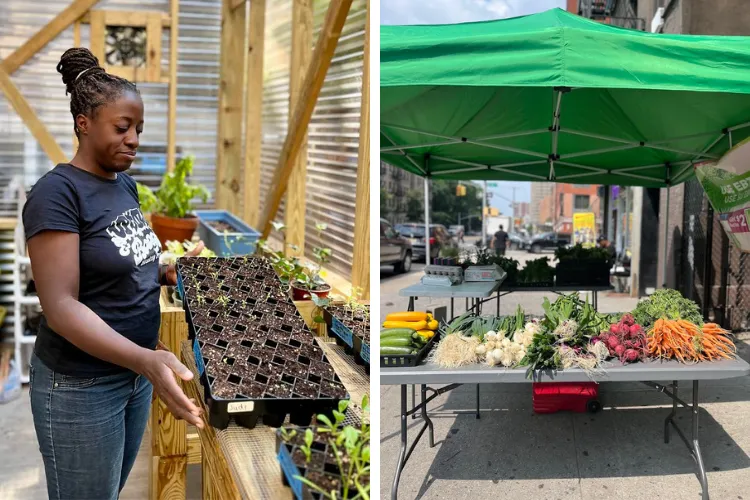
What is your perspective on the current state of sustainability efforts in New York City?
There are some representatives who are addressing the need for more sustainability programs and providing financial support for those taking the initiative to compost in their communities, but progress has been slow. We’ve been advocating, and hopefully, more funding will be provided next year. Private foundations have stepped in to help with funding, which is good, but more support should be coming from the city and government side.
A new initiative we’ve taken on at the Saint Nicholas Miracle Garden is water harvesting. The New York City Department of Environmental Protection has been putting the focus on having more conversations about water harvesting, adding rain barrels to homes, and explaining to people the benefits of collecting and storing rainwater. It’s imperative to talk about these things because we’re starting to see droughts.
The program has been wonderful, but unfortunately, it lacks funding. Our garden received one of the last barrel distributions, and we’re using it to harvest water for our greenhouse. We see this often, where every time there’s a conversation about building sustainability projects, there ends up being budget cuts.
What are your thoughts on the importance of advancing food justice in communities like Harlem?
In Harlem, like other places, you don’t know what you don’t know. As a community, we know we need to eat healthy, but how do we get consistent access to healthy food? People know they can go to the grocery stores, but we don’t just want food; we want fresh food. We want food straight from the farm because it tastes different.
Our Uptown Good Food farm stand and our Farmers Markets are Community Supported Agriculture (CSA) programs, and our membership is very diverse. A part of food justice is educating people about what their benefits can do.
Supplemental Nutrition Assistance Program (SNAP) benefits allow you to get food from the farmers' market. There’s also a local program called Health Bucks, where you can get an additional $10 to pick up even more fruits and vegetables. The WIC program also offers vouchers to use at farmers markets. Locally, we need to keep sharing this information to help people make the most of their benefits.
Another element of food justice that isn’t discussed enough is the time it takes to access food. In Harlem, we host our farm stands in the evenings for people just getting off work, and in the Bronx, we hold markets on Sundays because many residents use Saturdays to run other errands.
There is also something special about having in-person interactions with farmers. People who stop by are always talking to them about how they grow their produce and what can help them adopt healthier lifestyles. Oftentimes, people want to find more natural ways for healing before turning to medication. I’ve had many people stop by and share that once they started eating healthier, they are taking less medication.
We need to show people you can grow Lemon balm in your house—or we can grow the seedlings for them in the garden, and they can use it to make tea. We take a grassroots approach to everything we do. We need to give the Harlem community what it’s asking for. The conversations are there, but there needs to be more effort around access and education, and that’s what I feel food justice is.
The conversations are there, but there needs to be more effort around access and education, and that’s what I feel food justice is.
How has Uptown & Boogie Healthy Project collaborated with Columbia University in the past?
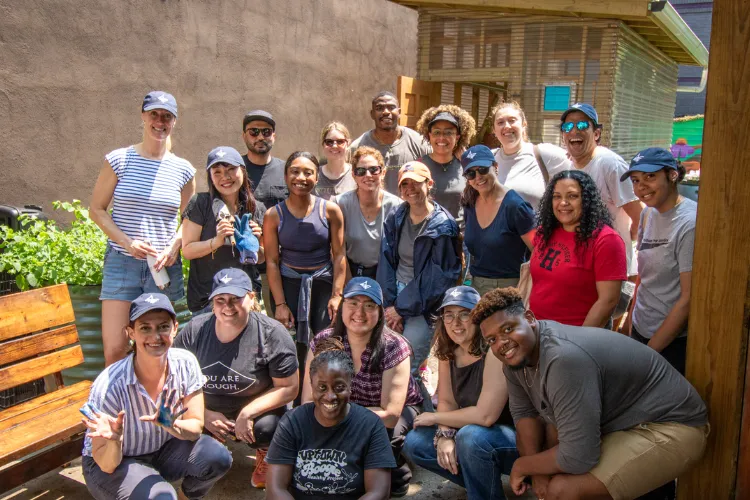
Pat Lilly came with staff from Columbia Business School for a corporate volunteer day. There were about 20 people who stopped by the garden, and they helped paint and laminate our tables and benches. It took us four years to try to make that happen, and they did it within two hours. They did a great job. They came and re-sanded all of the tables and benches and coated them with Linseed oil.
Another Columbia connection was by happenstance. Our now-resident architect, Leslie, was studying architecture at Columbia last year and needed to work on a project that showed her skills. She used her expertise to work on the plan for our farmstand and collaborated with carpenters to build it out using hand tools. She’s become a treasure to us. It turned into a really great project, and we “adopted” her. We now consult with her on many of our projects, including building a garden on top of one of the sheds.
What’s new and on the horizon at the Saint Nicholas Miracle Garden?
This year, we’re part of NYC Parks GreenThumb and Audubon Mural Project’s collaboration to put bird murals on community garden sheds. We have a newly-painted mural of a bird and a native plant created by artist Marthalicia Matarrita.
We’ve also turned the roof of the shed into a garden. We received a grant from the Citizens Committee for New York City to make that happen. We’ve taken a pollinated garden bed, incorporated native plants, and put it on top of the shed. Since the garden is small, it really pushed us into utilizing vertical growing. We also want to introduce IoT gardening into our greenhouse to produce more seedlings for community members. The garden lacks sun, so we’ve been using a solar panel gifted to us by Brooklyn SolarWorks.
We’re also focused on educating the community about how to grow microgreens and how to automate water flow. We’ve partnered with the Center for Agricultural Development & Entrepreneurship (CADE), Cornell Cooperative Extension, NYC Pollinator Working Group (NYCPWG) on those efforts. We have so many birds that visit our garden, and we’re working with Woodsmiths to create little birdhouses to reduce lumber waste. It's part of a larger project called The Little Critters Homes, so birds, bees, and butterflies can have a place in the garden. We also plan to install a French drain around the greenhouse to prevent flooding.
How can people support the Saint Nicholas Miracle Garden and all of the other Uptown & Boogie Healthy Project initiatives?
People can donate. We’re fundraising for a refrigerator cargo van to bring more fresh food into the community. There isn’t enough cold storage in New York City, which often deters small farmers in places like upstate New York from bringing their food downstate. Harlem is hot. New York City is hot. We’ve transitioned into a subtropical zone. Cold storage is needed now more than ever to prevent food spoilage and reduce waste. Another element of food justice is ensuring a reliable and quality food chain supply system to support access and distribution in NYC.
We also need the funding to expand our team and programming. Our vision for 2026 is to focus on workforce development centered on tech and sustainability. We’re a tiny but mighty team trying to address things on a small scale to show that if we can do it, you can do it.